


You’re reading Friday Features, a weekly newsletter containing the Independent Herald’s feature stories — that is, stories that aren’t necessarily straight news but that provide an insightful look at our community and its people. If you’d like to adjust your subscription to include (or exclude) any of our newsletters, do so here. If you haven’t subscribed, please consider doing so!
Today’s newsletter is sponsored by First National Bank. Since 1904, First National Bank has been a part of Scott County. First National is local people — just like you. Visit fnboneida.com or call (423) 569-8586.

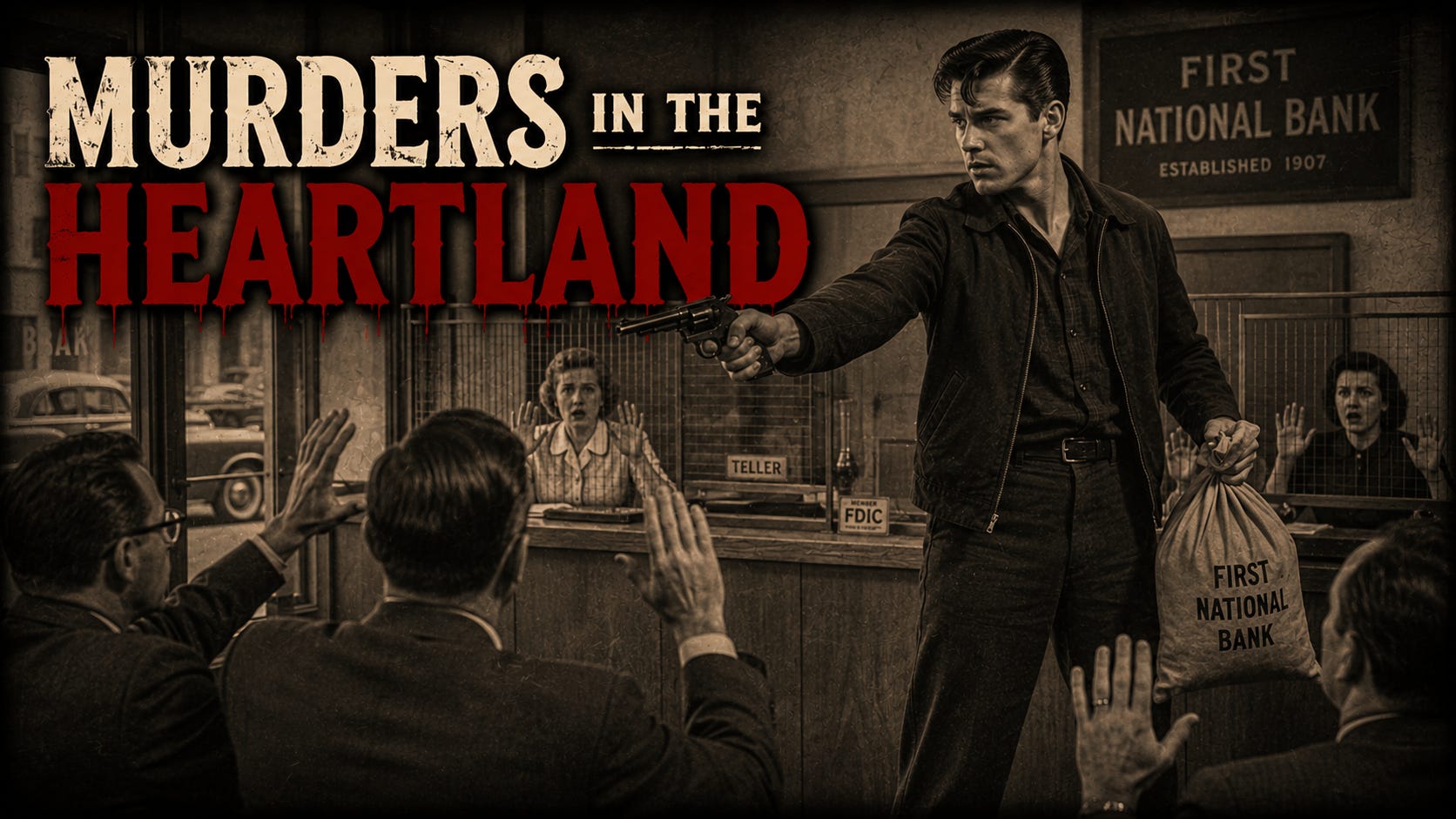
Who killed Baty Byrd?
Straight Fork • March 14, 1958
Virgil James Russell needed to get married.
Not wanted to get married. Men who want to get married save up for a ring, maybe a down payment on a house. Needing to get married implies something else entirely — like you’re so desperate to get married that you’re willing to rob a bank for it.
And, according to prosecutors in 1958, kill for it.
That’s the predicament Virgil James Russell found himself in on a cold spring day in 1958. He needed to get married, and he needed money to do so. What followed was a bank robbery at First National Bank of Oneida.
And then the discovery of retired coal miner Baty Byrd’s body, beaten to death in his Straight Fork home.
***
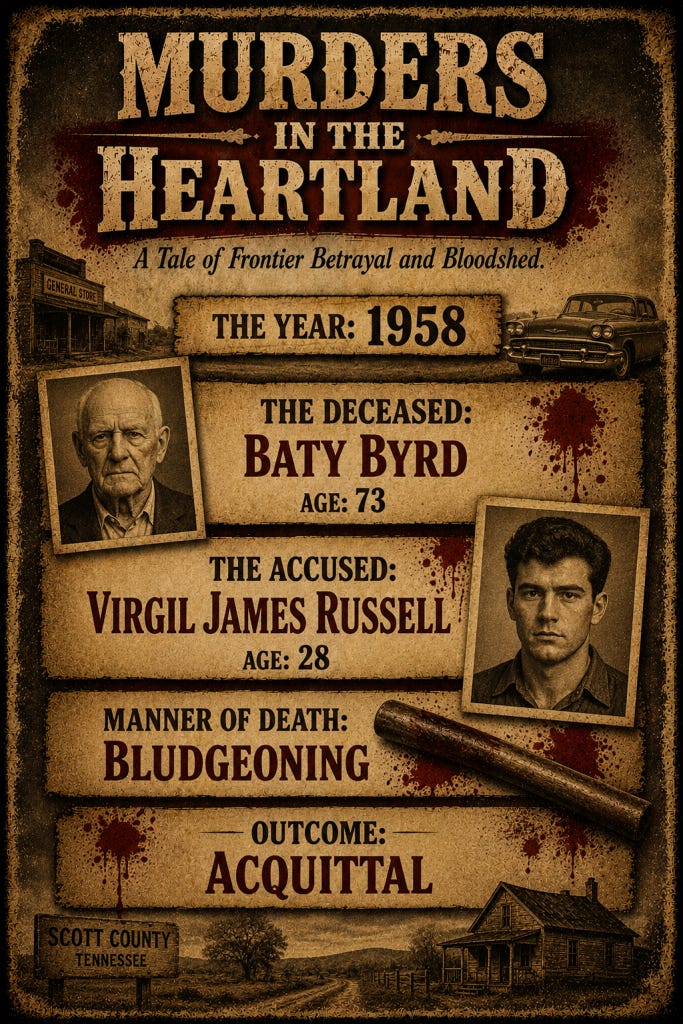
Federal authorities didn’t know they were nabbing a suspected murderer when they took Virgil Russell into custody in London, Ky. They simply thought that they were capturing a bank robber.
Of course, robbing a bank was serious business in 1958 Scott County — was anywhere, in fact, and still is today. Maybe more serious than murder.
After all, you wouldn’t ordinarily see the U.S. Marshal Service and the FBI set up a roadblock two hours away to catch someone who was suspected of fleeing the area after a murder. But that was exactly what played out as word spread that Russell had made off with about $6,000 from the Oneida bank.
It was at that roadblock in London, Ky., about three hours after holding up First National Bank, that Russell was apprehended. He still had all but $54 of the cash he had stolen from the bank, and the .38-caliber pistol he had used to hold up the bank. He readily admitted to robbing the bank, and that was that.
Until someone discovered 73-year-old Baty Byrd, brutally killed inside his home.
That sent Scott County Sheriff Dorsey Rosser and District Attorney General John Lee West through the mountains to the southeastern Kentucky coal-mining town on a mission: to bring Russell back here to face justice. The feds would prosecute the bank robbery, but Scott County wanted answers for Baty Byrd’s death. And they were convinced that Russell was the man responsible.
***
Virgil James Russell was born in 1929, the son of Ed Russell and Oma Sexton of the Straight Fork community in eastern Scott County. His parents called him “Virgie.” He grew up next to Baty Byrd, and visited Baty’s house often even after his family moved to Caryville in western Campbell County. He knew the old man.
And, apparently, he knew the old man had a gun.
So when he hatched a plan to rob the bank while home on leave from the U.S. Coast Guard, planning to get money to marry his sweetheart — a New Zealand girl living in Vancouver, whom he had met while stationed just across the border in Seattle — and he was found in possession of his old neighbor’s gun after the fact, he found himself facing the fight of his life. Not for the bank robbery; he admitted to that readily. But he adamantly denied that he had nothing to do with Byrd’s death.
***
William E. York Jr., an assistant cashier at the bank, was hailed as a hero. He remained calm during the robbery, provided an accurate description of Russell to authorities, and even got the license number of Russell’s car as he made his getaway.
That information is what led to Russell’s arrest less than three hours later. When he was stopped at the roadblock in London, he admitted to robbing the bank, admitted to taking $6,000, and even admitted that he was using Byrd’s gun. (He would later say at trial that he didn’t brandish the gun during the robbery; bank employees disagreed when they testified.) But he maintained that he had merely borrowed the gun from Byrd.
That was on Friday, March 14 — still two days before Byrd’s lifeless body would be discovered.
It was on a Sunday that Byrd’s nephew discovered him dead in his home — his body upright in a chair. Byrd, who was a widower and lived alone, had been struck twice in the head; Sheriff Rosser said it was likely a hatchet that was used to beat the old man to death. Dr. W.S. Cooper was called to the home to examine the body and concluded Byrd had been dead since Friday morning. Someone told authorities they had seen Russell entering and leaving Byrd’s home shortly before the bank was robbed during the lunch hour that day. And that quickly led to additional charges being lodged against him.
Things moved much more quickly in judicial circles back then. By the time the katydids started to sing their summer nights song, Russell had been convicted of robbing the bank and sentenced to 20 years in a federal prison in Atlanta.
Before the katydids had stopped singing that August, he had already stood trial in Huntsville on the murder charge, facing the death penalty.
At the trial, Evelyn Gibson testified for the state to say that she had seen Russell drive by her house — she lived next to Byrd — at 7:30 a.m. the morning Byrd was killed. Prosecutors theorized that Russell had killed the retired miner, who had also served as a deputy sheriff and constable, to get the gun he used to rob the bank.
Attorneys for Russell called tavern operators from Oneida who testified that he had been in Oneida that morning — nowhere close to Byrd’s Straight Fork home. And a defense witness, Ada Bolin, another of Byrd’s neighbors, said that she saw Byrd alive that Friday afternoon — about the same time Russell was being arrested in Kentucky. “I know I saw him, I know I spoke to him,” she said from the witness stand. She said she remembered when she saw him because she was headed back from the hospital with her husband — and even produced a bill from the hospital that was stamped March 14. That backed up Russell’s story that he had last seen his old neighbor and friend the night before, Thursday, when he visited to borrow the gun.
The jury couldn’t decide which witness to believe. Eight believed one woman; four believed the other. They reported to the judge that they were hopelessly deadlocked, and a mistrial was declared.
A new trial was scheduled for November, then delayed until January 1959. And, ultimately, Russell was exonerated. Jurors heard three days of testimony before returning a not guilty verdict.
Russell wasn’t completely in the clear; he was whisked back to Atlanta after the trial to serve his time for robbing the bank. But he had been cleared by a jury of his peers in the death of his long-time neighbor and friend.
And for Baty Byrd, justice would never come.
Editor’s Note: Baty Byrd was a father of six, but his children were all grown at the time of his death. His three daughters lived in Knoxville and Cincinnati, and all three of his sons were away in the U.S. armed forces. His wife, Rachel Allred, had died many years earlier, in 1934. That’s why Byrd’s body wasn’t discovered until his nephew went to check on him two days later. He was buried at Allred Cemetery. The last of his children, James P. Byrd, died in 2022 in Kentucky. Virgil James Russell served his time for robbing the bank, and later lived in Massachusetts and Cincinnati. He died in 2002.
--
This is the latest installment of Murders in the Heartland, the Independent Herald‘s reimagined series that examines notable murders that have occurred through the years in Scott County. Once the series is complete, the book by the same name will be republished in a second edition. Please note that descendants of both the victims and perpetrators of this series still reside in Scott County today. The intent is not to judge or to rip scabs off old wounds, but to examine how key incidents have indelibly impacted our community through the years.
Thank you for reading. Our next newsletter will be The Daybreaker bright and early Monday morning. If you’d like to update your subscription to add or subtract any of our newsletters, do so here. If you haven’t yet subscribed, it’s as simple as adding your email address!
◼️ About the IH • IH Sports Network • The Encyclopedia of Scott County
◼️ Subscribe • Sponsor • Manage Your Account
◼️ Follow us on Facebook, Instagram, X/Twitter, YouTube
Our Newsletters:
• Monday morning: The Daybreaker (news & the week ahead)
• Tuesday: Echoes from the Past (stories of our history)
• Wednesday: Threads of Life (obituaries)
• Thursday evening: The Weekender (news & the weekend)
• Friday: Friday Features (beyond the news)
• Sunday: Varsity (a weekly sports recap)