


You’re reading “Echoes in Time,” a weekly newsletter by the Independent Herald that focuses on stories of years gone by in order to paint a portrait of Scott County and its people. “Echoes in Time” is one of six weekly newsletters published by the IH. You can adjust your subscription settings to include as many or as few of these newsletters as you want. If you aren’t a subscriber, please consider doing so. It’s free!
Today’s newsletter is sponsored by the Scott County Chamber of Commerce. Since 1954, the Scott County Chamber of Commerce has advocated for a strong community by supporting stronger infrastructure and leadership.

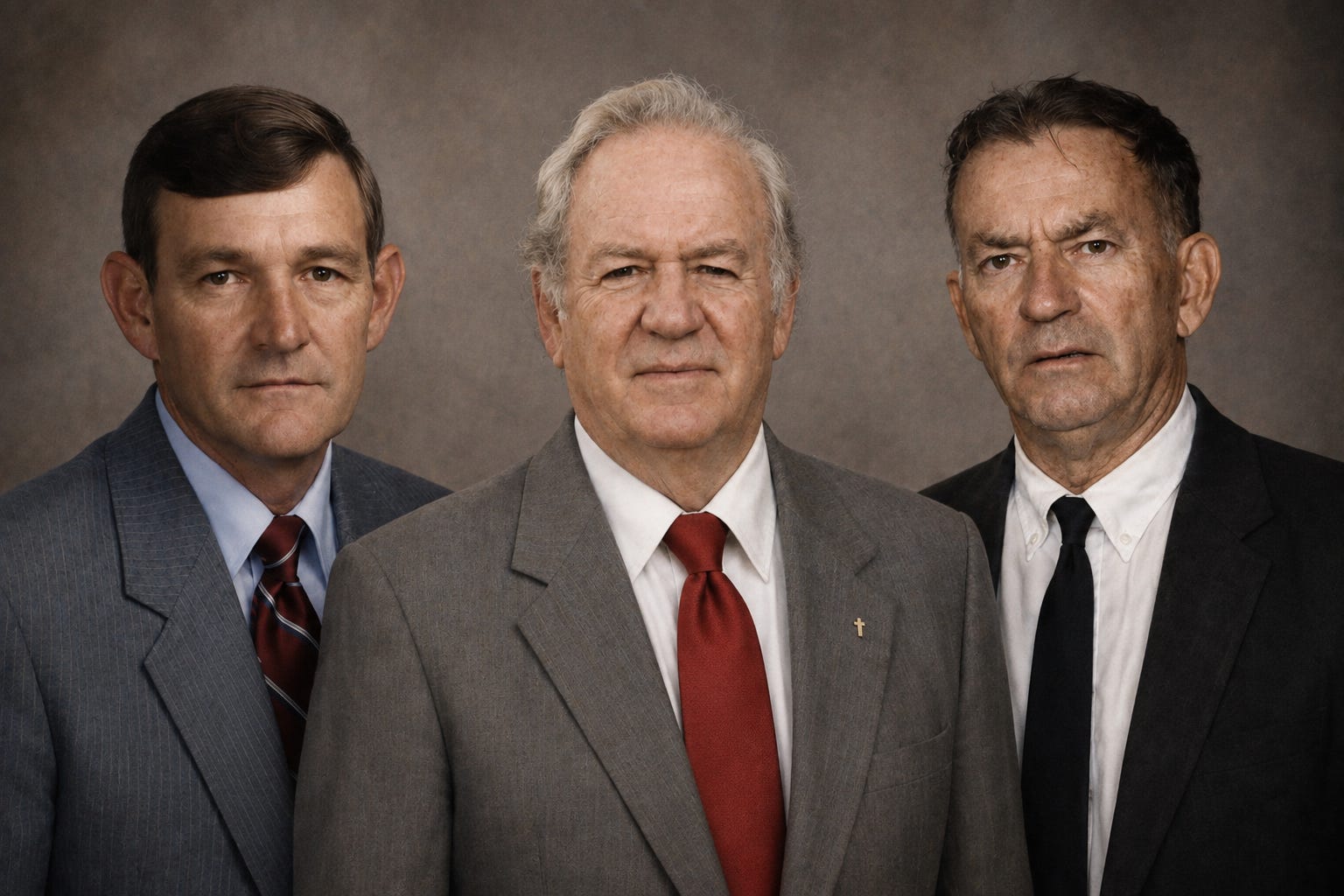
Scott County’s sheriffs through the years
It’s not a term that’s as common as it once was, but you’ll still find a few old-timers in far-flung parts of Scott County who make reference to the “high sheriff.” It was once common terminology, carried over from the “old country” — England, Wales, and Northern Ireland — where the “high sheriff” was the top peace officer and the undersheriffs were his deputies.
“High sheriff” has never been an official title in Scott County — or anywhere else in Tennessee. Around here, the official title has always been, simply, “sheriff.” And his deputies are called just that — “deputies,” though their official title is “deputy sheriff.” There are a few states where the office of “high sheriff” exists. In Rhode Island, for example, there’s a statewide sheriff’s department, and its top official is called the “executive high sheriff.” Hawaii also has a high sheriff. And in Rhode Island, each county has a “high sheriff” that has police powers throughout the state.
Later this week, Scott Countians will go to the polls to select a sheriff for the next four years. Brian Keeton, the first-term incumbent, will be seeking another term in office, and is being contested by two veteran law enforcement officers: Dennis Chambers and Kris Lewallen.
Keeton is the 33rd person to serve as Scott County Sheriff. Here’s a look at the others through the years:
Scott County’s first sheriff was John Lewallen (sometimes spelled Llewellyn). He was elected in 1850, in the county’s first election, and served until 1858. He was part of the Lewallen family from the Glenmary area. His father, Anderson Grant Lewallen, was the first settler in that part of what would eventually become Scott County.
Bailey Buttram, of New River, was Scott County’s second sheriff. He was elected in 1858 and served until 1964. He had the distinction of being the person who certified Scott County’s vote against secession. He carried the results to Nashville on horseback, and his handwritten note relating Scott County’s 521-19 vote against secession is still preserved in the state archives. (Interestingly, Buttram’s parents were Scott County’s most prominent slaveholders, but Bailey and his family were loyal to the Union. He had two sons who fought for the federal army and were captured at the Battle of Rogersville in 1863. One of them, Iradel, died in a Confederate prison camp. The other, Joel, survived, but died at a young age, likely as a result of illness he contracted while imprisoned. Buttram’s son-in-law, Beaty Cecil, also served in the Union army, riding to Nashville to enlist. He would later serve as Scott County Sheriff in his own right.
In addition to Lewallen (Glenmary) and Buttram (New River), most of Scott County’s early sheriffs were from the southern part of the county. James Sharp, the third sheriff, was from Winfield, and Milton Terry, the fifth sheriff, was the son of Oneida’s first settler, Josiah Terry.
Reuben Hurtt, the county’s seventh sheriff, was from New River, as was Cecil, the eighth sheriff. Frank Hughett, who served as sheriff on two different occasions, was from Brimstone. So was his successor, John Goad. The two men were related by marriage, and Goad served as sheriff in between Hughett’s two terms.
In between those men from the southern end of the county, Fowler Hatfield — a farmer from Bull Creek — served a single term as sheriff in the 1870s.
There was a time when the office of county sheriff was term-limited in Tennessee. Each person was limited to three terms in office, and terms in those days consisted of only two years. So after a maximum of six years, a sheriff had to sit out at least two years before being eligible to return to office.
Among the sheriffs who were term limited were Buttram, Sharp, Hurtt, and Hughett. Hughett was the first sheriff to return to office. After sitting out two years while his cousin-in-law, Goad, served a term as sheriff, he was elected again in 1898. He only served one term the second time around, and was unsuccessful in election attempts after that.
Speaking of Goad, he has the distinction of being the only sheriff from Scott County to ever legally hang a man. That man was Mike King, a Winfield resident who was convicted of murdering a school teacher. The duty bothered Goad so much that he considered resigning — King famously told him to stay on as sheriff and carry out the duty — and he did not run for a second term. Instead, he ran for other elected offices.
Other sheriffs who were term-limited through the years included Gilbert Sexton, Frank Butler, Dorsey Rosser, and Jack Laxton.
Richard Ellis would have been term-limited, as well, but he was assassinated in office in 1925. He was a Baptist preacher who campaigned on a promise of cracking down on Scott County’s moonshine problem. It was the Prohibition era, and illicit liquor was rampant in the county’s remote hills and hollers. The 1920s proved to be the most violent era in the county’s history for law enforcement, as a full-scale moonshine war unfolded. Multiple people were killed, including Oneida Chief of Police Johnny Acres, who served as one of Ellis’s deputies.
On Aug. 11, 1925, Ellis was shot dead on the steps of the old county jail in Huntsville as he escorted a prisoner inside. The killers shot him from ambush, and it was never conclusively proven who was responsible, although several arrests were made.
Ellis was not the last person to die in office. In fact, his successor, Isham Chambers of Buffalo, died of the flu in 1929. Many years later, Mike Cross died of cancer in 2013.
Another sheriff, Butler, almost died in office. He was severely wounded during a gun battle outside a Winfield tavern in 1947.
Two other sheriffs were assassinated shortly after their terms in office. Hughett was killed from ambush in the Smokey Junction area in 1910 after leading a posse that had killed Riley Low. He was a candidate for election at the time of his death. And William J. West — who had famously helped three black murder suspects charged with killing a supervisor at the Robbins Brickyard escape lynching by leading them out of Scott County under the cover of darkness — had been shot from ambush outside his home in the New Light area near Winfield in 1909.
Hughett had been the first sheriff to serve on multiple occasions, first from 1888 to 1894 and then from 1898 to 1900. The second to do so was Esau Laxton, who replaced Isham Chambers after Chambers died of illness in 1929. Laxton served until 1934, and then from 1936 to 1938.
Laxton was also part of the first — and, to date, only — father-and-son team to serve as sheriffs. His son, Jack Laxton, was first elected sheriff in 1962, and later served as sheriff from 1986 to 1994.
The 1940s saw an interesting political rivalry unfold between Frank Butler and Dorsey Rosser. Butler served as sheriff for six years before being term-limited in 1944. Then, after Rosser served as sheriff for two years, Butler beat him in 1946 to take the job back. After being wounded in the Winfield shootout, Butler did not run in 1948 while he recovered, and Rosser won again. But Butler was elected again in 1950, serving six more years before again being term-limited in 1956. Rosser then took office in 1956 and served until 1962, when Laxton was elected.
Butler and Jack Laxton were Scott County’s longest-tenured sheriffs, each serving a total of 14 years in the office. The longest anyone has served consecutively is Jim Carson, who served 12 years, from 1994 to 2006. His brother, Marion Carson, would have served at least 12 years, but was indicted by federal authorities in 1986. He was one of nine current or former sheriffs in East Tennessee indicted by the FBI as part of “Mach Tenn,” a lengthy undercover investigation. Federal agents posed as cocaine smugglers and worked their way into Carson’s trust before asking him to aid their efforts. Carson pleaded guilty and resigned his office. He was sentenced to 15 years in prison, but died of cancer a few years later.
Carson had been one of the most popular sheriffs in Scott County’s history prior to his arrest. He and Jack Laxton developed a fiercely competitive political rivalry in the 1970s that was much the same as the Frank Butler-Dorsey Rosser battles of the 1940s. Laxton had been term-limited in 1968 and replaced by Bernard Brummet. Later, when Julius Lewallen was elected sheriff in 1972, Carson served as one of his deputies. When Lewallen opted against seeking re-election to a third term in 1976, Carson ran. So did Laxton. Only a few votes separated the two, with Carson winning. They squared off again in 1978 and again Carson won narrowly.
When Carson resigned his office, his chief deputy, Chester Sexton, was appointed by County Commission to fulfill the remainder of his term. Sexton did so, serving as acting sheriff until Laxton won the 1986 election.
Laxton then served two more four-year terms before losing to Jim Carson — Marion’s brother — in 1994. Jim Carson served three terms before Anthony Lay won the 2006 election to become the youngest sheriff in the county’s history. Lay resigned near the end of his first term to take a job with the U.S. Marshal Service, and Mike Cross — then the Oneida chief of police — was elected to replace him. Following Cross’s death, his chief deputy, Ronnie Phillips, was appointed by County Commission to fill the remainder of his term. Phillips was elected in 2014 and re-elected in 2018, serving a total of nine years in office before Brian Keeton — who had lost to Cross in the 2010 campaign — won election in 2022.
The first sheriff in Scott County who killed a man was John Goad, who hanged Mike King as part of his official duties. A decade later, Frank Hughett killed Riley Low while executing an arrest warrant, and was assassinated as an act of revenge a few months later. Gilbert Sexton had been accused of gunning down Riley Cecil in 1883 — along with his brothers — as part of the Cecil-West-Smith feud, though that was well before he became sheriff. Richard Ellis was part of a moonshine still raid that killed Filmore Sexton in 1924, though it isn’t clear who fired the fatal shot. Herbert Bilbrey was present when game warden Lindsay Phillips was killed in 1936. In fact, Phillips was there to serve a warrant on Bilbrey. Bilbrey was not implicated in Phillips’ death. However, one of the men who was, Dorsey Rosser, would later serve as sheriff on multiple occasions.
Echoes in Time is published by the Independent Herald each Tuesday.
Thank you for reading. Our next newsletter will be Threads of Life tomorrow. If you’d like to update your subscription to add or subtract any of our newsletters, do so here. If you haven’t yet subscribed, it’s as simple as adding your email address!
◼️ About the IH • IH Sports Network • The Encyclopedia of Scott County
◼️ Subscribe • Sponsor • Manage Your Account
◼️ Follow us on Facebook, Instagram, X/Twitter, YouTube
Our Newsletters:
• Monday morning: The Daybreaker (news & the week ahead)
• Tuesday: Echoes from the Past (stories of our history)
• Wednesday: Threads of Life (obituaries)
• Thursday evening: The Weekender (news & the weekend)
• Friday: Friday Features (beyond the news)
• Sunday: Varsity (a weekly sports recap)