


You’re reading “Echoes in Time,” a weekly newsletter by the Independent Herald that focuses on stories of years gone by in order to paint a portrait of Scott County and its people. “Echoes in Time” is one of six weekly newsletters published by the IH. You can adjust your subscription settings to include as many or as few of these newsletters as you want. If you aren’t a subscriber, please consider doing so. It’s free!
Today’s newsletter is sponsored by the Scott County Chamber of Commerce. Since 1954, the Scott County Chamber of Commerce has advocated for a strong community by supporting stronger infrastructure and leadership.

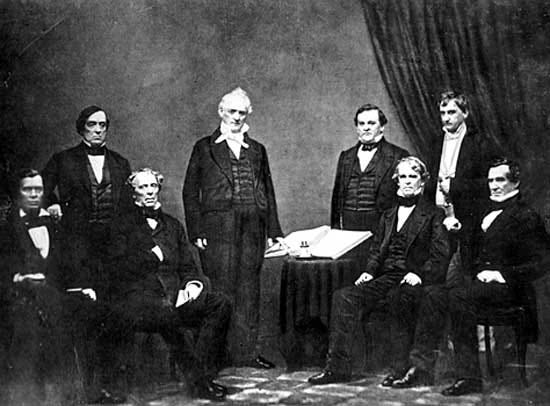
Scott County’s last vote for a Democratic presidential candidate
Only once in Scott County’s 177-year history has its people supported a Democrat for president. And only three times have a majority of the voters here not supported the Republican nominee for president. And there’s a reason behind that.
To find the only time a majority of Scott Countians voted for a Democrat for president, you have to go back to 1856, when the county’s voters narrowly supported Pennsylvania Democrat James Buchanan over New York Know Nothing party nominee Millard Fillmore.
That year was the first presidential election for the newly-formed Republican Party, which had been born in Wisconsin with opposition to the expansion of slavery at its core. Its candidate, John C. Frémont, was not on the ballot in Tennessee.
Buchanan, who won a narrow majority of the vote in Scott County in 1856, had originally been a member of the Federalist Party. During his five-term tenure in the U.S. House of Representatives, he had aligned himself with Andrew Jackson’s Democratic Party. He was generally supportive of slavery — the issue that was tearing at the fabric of the union of states even by 1856 — and intervened in the U.S. Supreme Court’s Dred Scott decision after winning the election (but before taking office).
Officially, Scott County is one of three in Tennessee that have not supported a Democrat for president since 1856. The other two are Hancock County and Washington County. However, voters in both Hancock and Washington supported Southern Democrat John C. Breckinridge in the 1860 election, after the Democratic Party had fractured. This leaves Scott County as the only county in Tennessee that has not voted for a Democrat for president since 1856.
What happened?
The same thing that led Scott County to defy Nashville and declare its independence from Tennessee in 1861: the secession crisis and the civil war that followed.
In 1852, the first presidential election after Scott County was formed, Scott Countians voted for Whig candidate Winfield Scott — the county’s namesake — in his race against Democrat Franklin Pierce. In fact, this area had routinely supported the Whig Party prior to 1856. In 1848, Campbell County, Anderson County and Morgan County — the counties that Scott County would be formed from the following year — voted for Zachary Taylor, the Whig from Louisiana. Four years before that, they voted for Whig Henry Clay over Tennessee’s own James K. Polk.
But the 1856 election showed that Scott County would also support a Democrat. Jehu Phillips, a prominent Scott Countian who was deeply involved in local politics, would later write that Scott County was evenly divided between Whigs and Democrats prior to the Civil War.
Then came 1860, and everything changed.
That year, the still-new Republican Party created a firestorm by nominating Illinois attorney Abraham Lincoln for president. Lincoln — a rough-around-the-edges frontier lawyer — had emerged as a national political figure because of his stance against the expansion of slavery. The South was convinced that his election would mean the end of slavery, and Tennessee’s governor, Isham Harris, had already threatened secession — as had other Southern political leaders.
Lincoln was not on the ballot in Tennessee that year, though he received a single vote in Scott County from Shade Lewallen — presumably a write-in vote. Instead, Scott County joined the rest of the state in supporting Constitutional Union party candidate John Bell — a native of Tennessee — over Southern Democrat John C. Breckinridge, who was Buchanan’s vice president.
Fentress and Morgan counties supported Breckinridge. Campbell and Anderson counties voted the same way Scott County did.
In Scott County, more than 60% of the voters cast their ballots for Bell. Only one voter was for Stephen Douglas, the Democrat nominee who had risen to fame through his debates with Lincoln.
Despite not being on the ballot in the South, Lincoln won the election. The South was incensed, and secession followed. Tennessee’s first secession vote, held just three months after the 1860 election, failed. But Harris forced a second secession vote, and Middle Tennesseans — influenced by the events at Fort Sumter that had started the war — switched their support from pro-Union to pro-secession.
The secession vote incensed East Tennessee, which remained strongly unionist. Representatives from counties throughout the region met in Knoxville and Greeneville and voted to petition the state to allow a split, with East Tennessee becoming its own state. When Nashville said “no,” Scott Countians decided to put rhetoric into action. In December 1861 — at least, that was the theory of Independent Herald founder and historian Paul Roy; the official records were lost or destroyed during the war so no one knows the exact date — Scott County Court voted to secede from Tennessee and form the Free & Independent State of Scott.
The Unionist stance in Scott County was complicated. Unlike the plantations of West Tennessee and the expansive farms in Middle Tennessee, the rocky soil of the Cumberland Plateau did not make commercial farming much of an option here. As such, the farms were largely subsistence operations — supporting single families, and not generating anything more than what the family needed to survive. Slaves were nearly non-existent. There were fewer slaves owned in Scott County — only 59 when the 1860 census was taken — than in any other county in Tennessee.
With slavery a moot issue here, Scott Countians were deeply opposed to secession — not because they favored abolishing slavery, but because most of the people who lived here were descendants of Revolutionary War veterans who were deeply keen of the sacrifices that had been made by the nation’s founding generation and believed strongly that the Union was worth saving.
“East Tennesseans stood their ground. They proved to the overwhelming majority of Tennesseans their loyalty to the Union. East Tennesseans had played important roles in helping to make the United States; they were not going to be a party to its destruction — no never!” historian Esther Sharp Sanderson wrote in her book, County Scott and Its Mountain Folk.
This view was exactly opposite of men like Robert E. Lee and Jefferson Davis, who opposed secession but ultimately believed that loyalty to state was more important than the Union because — in their view — the Union was built on the explicit consent of the states.
Writing for the Cumberland Chronicle in 1904, Jehu Phillips said: “I was raised a Democrat, but after the war nearly every citizen in this county voted the Republican ticket and have been doing so in this county since that time.”
The war forever changed the politics of Scott County. When Abraham Lincoln ran for re-election in 1864, he won Scott County, although the votes didn’t count because Tennessee had not been readmitted to the Union. And every Republican candidate since has carried Scott County — almost always by overwhelming margins.
In 1872, when Ulysses S. Grant ran for re-election, Scott Countians supported him by the largest margin of any county in Tennessee.
Four years later, in the presidential election of 1876 that resulted in a constitutional crisis and a premature end to Reconstruction, Scott Countians voted for Republican Rutherford B. Hayes by the largest margin of any county in Tennessee.
Throughout the remainder of the 19th century and into the early 20th century, Middle Tennessee and much of West Tennessee generally voted for the Democratic candidate for president, while East Tennessee — where secession had soured the people who were mostly Union loyalists — generally voted for the Republican candidate.
And, in each election, voters in Scott County and Sevier County consistently voted for the Republican candidate by larger margins than almost any other county in the state. This continued until 1912, when Theodore Roosevelt — who had easily carried Scott County eight years earlier — switched to the Progressive Party and much of East Tennessee cast its support to him. (Scott and Sevier counties voted for Roosevelt by a larger margin than any other county in Tennessee.)
For more than a century after the Civil War, secession and the war shaped the politics of Tennessee. East Tennessee always supported the Republican Party — viewing the Democrats as the party that had pulled them into a war they hadn’t wanted to fight. But West Tennessee (and, for the most part, Middle Tennessee) usually supported the Democrat Party — associating Republicans with the deeply unpopular Reconstruction policies.
In time, the impact of the Civil War on Tennessee’s presidential votes faded. But in Scott County, it has remained strong. In 2016, Scott Countians voted for Republican Donald Trump by the second-largest margin of any county in the state. In 2020, nearly 90% of Scott Countians voted for Trump — the largest margin of any county in the state. In 2024, an even larger margin of Scott Countians voted for Trump, again the largest of any county in the state.
Even Franklin D. Roosevelt, the Democrat president who helped guide the nation through the Great Depression, couldn’t flip Scott County. He made deep inroads in East Tennessee, flipping 22 counties (including Pickett and Campbell counties) from red to blue. In his 1936 re-election bid, he won Morgan and Anderson counties, as well.
But Scott Countians never voted for Roosevelt. And in 1944, East Tennessee shifted back to the Republican side, favoring Thomas E. Dewey over Roosevelt.
In 1964, when Lyndon B. Johnson was winning Morgan, Campbell and Anderson counties, Scott County again bucked its neighbors, supporting Republican Barry Goldwater by a slim majority.
And in 1968, as the civil rights turmoil roiled the region and caused many voters to switch their support to George Wallace, Scott Countians voted for Richard Nixon. (The rest of East Tennessee also voted for Nixon.)
Jimmy Carter was just the second Democrat presidential candidate since secession to make serious inroads in East Tennessee. He carried the vote in every county adjoining Scott County except Pickett County. But he didn’t win Scott County; voters here narrowly supported Republican Gerald Ford. It was the closest Scott County had come to voting for a Democrat for president since the Civil War, but Ford won 51.4% of the vote here.
In 1992, Bill Clinton became the third Democrat since secession to gain major support in East Tennessee. He won every county adjoining Scott County — but, like his predecessors, he didn’t win Scott County. Scott Countians voted for George H.W. Bush (though it was the first time since the Civil War, with the exception of Roosevelt’s third-party bid in 1912, that fewer than 50% of Scott Countians voted for the Republican candidate, with Ross Perot gaining nearly 10% of the vote here).
Scott County’s neighbors continued to support Clinton in 1996, but a majority of the voters here cast their ballots for Republican Bob Dole — though, again, Dole got less than 50% of the vote in Scott County due to Perot’s presence on the ballot. Dole received 46.9% of the vote in Scott County that year, while Clinton received 44.5% of the vote. It was the closest a Democrat has come to winning Scott County since the Civil War.
The last time a Republican candidate received less than 60% of the vote in Scott County was in 2004, when George W. Bush received 59.1% of the vote and John Kerry captured 40.5%.
Here is the presidential candidate Scott Countians have supported by year:
1852: Winfield Scott, Whig
1856: James Buchanan, Democrat
1860: John Bell, Constitution
1864: Abraham Lincoln, Republican
1868: Ulysses S. Grant, Republican
1872: Ulysses S. Grant, Republican
1876: Rutherford B. Hayes, Republican
1880: James A. Garfield, Republican
1884: James G. Blaine, Republican
1888: Benjamin Harrison, Republican
1892: Benjamin Harrison, Republican
1896: William McKinley, Republican
1900: William McKinley, Republican
1904: Theodore Roosevelt, Republican
1908: William Howard Taft, Republican
1912: Theodore Roosevelt, Progressive
1916: Charles Evan Hughes, Republican
1920: Warren G. Harding, Republican
1924: Calvin Coolidge, Republican
1928: Herbert Hoover, Republican
1932: Herbert Hoover, Republican
1936: Alf Landon, Republican
1940: Wendell Willkie, Republican
1944: Thomas E. Dewey, Republican
1948: Thomas E. Dewey, Republican
1952: Dwight D. Eisenhower, Republican
1956: Dwight D. Eisenhower, Republican
1960: Richard Nixon, Republican
1964: Barry Goldwater, Republican
1968: Richard Nixon, Republican
1972: Richard Nixon, Republican
1976: Gerald Ford, Republican
1980: Ronald Reagan, Republican
1984: Ronald Reagan, Republican
1988: George H.W. Bush, Republican
1992: George H.W. Bush, Republican
1996: Bob Dole, Republican
2000: George W. Bush, Republican
2004: George W. Bush, Republican
2008: John McCain, Republican
2012: Mitt Romney, Republican
2016: Donald J. Trump, Republican
2020: Donald J. Trump, Republican
2024: Donald J. Trump, Republican
Echoes in Time is published by the Independent Herald each week on Tuesday.
Thank you for reading. Our next newsletter will be Threads of Life tomorrow. If you’d like to update your subscription to add or subtract any of our newsletters, do so here. If you haven’t yet subscribed, it’s as simple as adding your email address!
◼️ About the IH • IH Sports Network • The Encyclopedia of Scott County
◼️ Subscribe • Sponsor • Manage Your Account
◼️ Follow us on Facebook, Instagram, X/Twitter, YouTube
Our Newsletters:
• Monday morning: The Daybreaker (news & the week ahead)
• Tuesday: Echoes from the Past (stories of our history)
• Wednesday: Threads of Life (obituaries)
• Thursday evening: The Weekender (news & the weekend)
• Friday: Friday Features (beyond the news)
• Sunday: Varsity (a weekly sports recap)