


You’re reading “Echoes in Time,” a weekly newsletter by the Independent Herald that focuses on stories of years gone by in order to paint a portrait of Scott County and its people. “Echoes in Time” is one of six weekly newsletters published by the IH. You can adjust your subscription settings to include as many or as few of these newsletters as you want. If you aren’t a subscriber, please consider doing so. It’s free!
Today’s newsletter is sponsored by the Scott County Chamber of Commerce. Since 1954, the Scott County Chamber of Commerce has advocated for a strong community by supporting stronger infrastructure and leadership.

Scott County’s communities: Helenwood
Helenwood is an unincorporated community in central Scott County. It was once an important station and town along the Southern Railroad, and was populated in the late 19th and early 20th centuries as coal was mined nearby. Once the coal ran out, however, Helenwood was slowly bypassed by the growing towns of Huntsville and Oneida. In 1997, an attempt to incorporate the community was struck down by a court.
Helenwood is one of the most difficult communities in Scott County to define geographically, because as the 20th century progressed, it came to be used as the place name for virtually all of central Scott County outside of Oneida and Huntsville. At the same time, Huntsville’s corporate limits have slowly overtaken large parts of what was once considered Helenwood. Scott High School, for example, was once considered to be a part of Helenwood. Today, Huntsville incorporates much of the U.S. Highway 27 and S.R. 63 corridors, from New River on the south end to near Oneida’s southernmost boundary on the north end to near Buffalo Creek on the east end.
Traditionally, however, Helenwood was neatly defined as the small town that grew up around the railroad depot after the Southern Railroad opened for train traffic in 1880. It developed a reputation as a bit of a rough-and-tumble saloon town, and was the site of a number of murders in the late 1800s and early 1900s — including the murder of standout University of Tennessee football player Sam Young Parker in 1907. In the 1930s, much of the original town was damaged by a dynamite blast.
Helenwood was traditionally the gateway to Huntsville. After the railroad was built, train passengers would disembark at the Helenwood depot and catch taxis to Huntsville via the Monticello Pike, which was the only paved road in Scott County at the time. As automobiles became the preferred method of travel in the early to mid 20th century, that changed. U.S. Highway 27 was constructed through Scott County from north to south, and S.R. 63 from east to west. For the first time, Huntsville and Oneida were directly linked by major highways, rendering the railroad less important for passenger transport.
For the purposes of this profile, Helenwood will include the communities of Cherry Fork and Sulpher Springs, which were once important settlements in early Scott County.
GEOGRAPHY: From the town that sprang up around the railroad depot in the 1880s, Helenwood eventually came to refer to the larger geographic area served by the Helenwood Post Office (zip code 37755), which included everything south of Oneida, west of Huntsville, north of Robbins, and east of Allardt.
Today, the geographic area covered by the 37755 zip code is significantly smaller than Oneida, Huntsville, or Robbins, covering 37.92 square miles with a population of 3,567 people, or 94 people per square mile. By comparison, Robbins to the south covers 104.77 square miles, with a population density of only 25 people per square mile. Huntsville covers 118.22 miles, and Oneida covers 147.31 miles.
Helenwood almost became Scott County’s fourth incorporated town in the 1990s, but a court battle against it was successful. Today, all of Helenwood’s territory along the U.S. Highway 27 corridor is part of the urban growth boundary of either Huntsville or Oneida. The city limits of Huntsville actually include most of the old town of Helenwood, running along Helenwood Main Street to Helenwood Detour Road, then north along Detour Road to the Mid-County Industrial Park, then north along the railroad to near Airport Road. The industrial park itself is not part of Huntsville.
Helenwood is drained by Phillips Creek, which has headwaters along the railroad to the north of town and runs through the center of what was once the main part of town, eventually draining into New River just south of the U.S. Highway 27 bridge. The West Branch of Phillips Creek is dammed to form what is commonly called the Stump Pond along Helenwood Loop Road.
Traditionally, before the modern highway system was developed, a pike (paved with brick) ran from Huntsville to Helenwood. Today, portions of that old road remain as West Monticello Pike and East Monticello Pike. It was largely replaced with the construction of S.R. 63. Another road traveled northeast along Sulphur Creek to Paint Rock. Today, this road is called Sulphur Creek Road. It still follows the original route, crossing U.S. Highway 27 and eventually intersecting with Main Street at Firefly Lane. From the railroad depot, a main road continued west to Silcox Ford at New River, where horses and wagons crossed the river and continued on to Grassy Knob near Robbins. Another main road left the depot and followed the railroad north toward Oneida. That road is today called Helenwood Detour Road. It was replaced with the construction of U.S. Highway 27 in the 1920s. However, the main method of travel between Helenwood and Oneida was train until the highway was built.
BUSINESS & COMMERCE: Helenwood has long played a key role in the industrial success of Scott County, dating back to the 1880s, when coal was discovered in the Sulphur Creek area east of town. A railroad spur was built into that area to accommodate mining efforts. During those early days, Helenwood was particularly famous — or, rather, infamous — for its saloons.
In the 1980s, Helenwood became the location of Cumberland Wood Products, which made wooden reels. Cumberland Wood remains today at the Mid-County Industrial Park, though it is no longer the major employer it once was. Also located at the industrial park is Takahata Precision Tennessee, a factory that makes precision-molded auto parts. It has grown to become one of the largest employers in Scott County. Next door, Container Technologies Industries Inc. makes nuclear waste containers. Down the road is Scandia USA, which makes baler belts and other sheet rubber products, along with TM Hardwoods LLC and BT Belting Inc.
Helenwood was also home to Twin K Construction for a period of time, located in the former Haliburton building on the north side of town.
Along the highway is Helenwood Foods and Perdue’s Shell, though both are now located within the Town of Huntsville. Citizen Gas Utility District’s headquarters are also located in what was once Helenwood, now Huntsville. Brawner’s Scrap Yard is located next-door to Helenwood Foods, and J&W Tire and Service Center is located on the other side.
R&J Produce, which got its start as a roadside produce truck in the 1980s (located at a gravel pull-off along the old highway near where RaeZack’s is now located) before later building a permanent location, is another business on the U.S. 27 corridor that now falls within the Town of Huntsville. So, too, are Twenty-Seven Hardware & Supply and Pappy’s Peddler’s Mall.
On the north side is the shopping center that houses RaeZack’s restaurant, along with Floor Fashions and Smokey’s Tobacco Outlet.
CHURCHES & CEMETERIES: The primary church in Helenwood is Helenwood Baptist Church, which was established in December 1906 by a delegation from Pine Creek United Baptist Church. Prior to 1906, Baptists met in the town’s schoolhouse. Helenwood also has the St. Jude Catholic Church. Remarkably, for a county with almost 100 churches, those are the only two churches located in Helenwood. Traditionally, there was a Presbyterian church located in Helenwood, dating back to the early 1880s, but it disbanded in the mid 1900s. There are additional small churches located in the Cherry Fork area.
Two main cemeteries served the town. The first was the Helenwood Cut Cemetery, so called because the Southern Railroad cut through the hillside adjacent to the graveyard. The second, which came later, was the Daniel Memorial Cemetery next door to the Baptist church. There are a number of smaller family cemeteries scattered throughout the community.
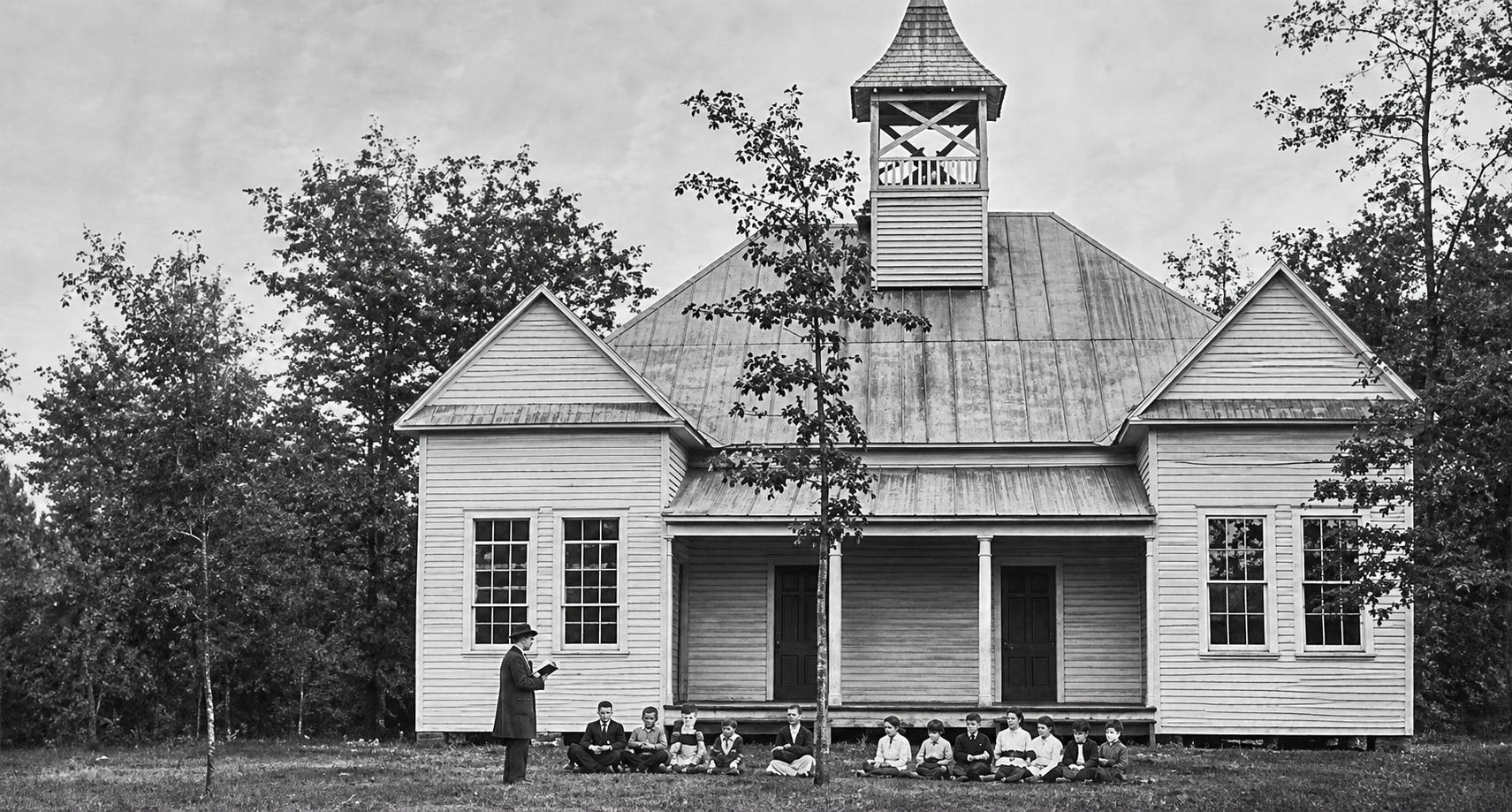
SCHOOL: The first school in Helenwood, called simply “The Helenwood Schools,” was built in the 1890s. A larger school was built in 1912, and the original school was sold to Helenwood Baptist Church for $50. It was used until the current church building was constructed in 1947.
Helenwood was also home to the Treat School for Boys, which was established by Edward and Wilma Treat in 1910 and housed in the defunct Campbell Coal Co. buildings. It operated until 1917 and had a summer campus at Martha’s Vineyard in Massachusetts.
There were also outlying schools at Sulphur Springs and Blaze Gum, as well as a school at Cherry Fork.
Today, students from Helenwood are served by Huntsville Elementary School, Huntsville Middle School, and Scott High School.
POST OFFICES: The first post office in the Helenwood area was established in March 1877 and called Parch Corn. Calvin C. Terry was the postmaster. It closed in January 1892 and merged with the Helenwood Post Office. The last postmaster was Lorenzo D. Marcum.
The Helenwood Post Office opened in 1880 and remains in operation today. Writing for the FNB Chronicle, Kathleen West Pennington said that the post office started in the office of Dr. Newman in March 1880, with Alvin Parker serving as postmaster.
The Chambers Post Office opened in February 1885. J.C. Parker was the postmaster for nine days, then Francis M. Chambers was named postmaster. It closed in November 1886.
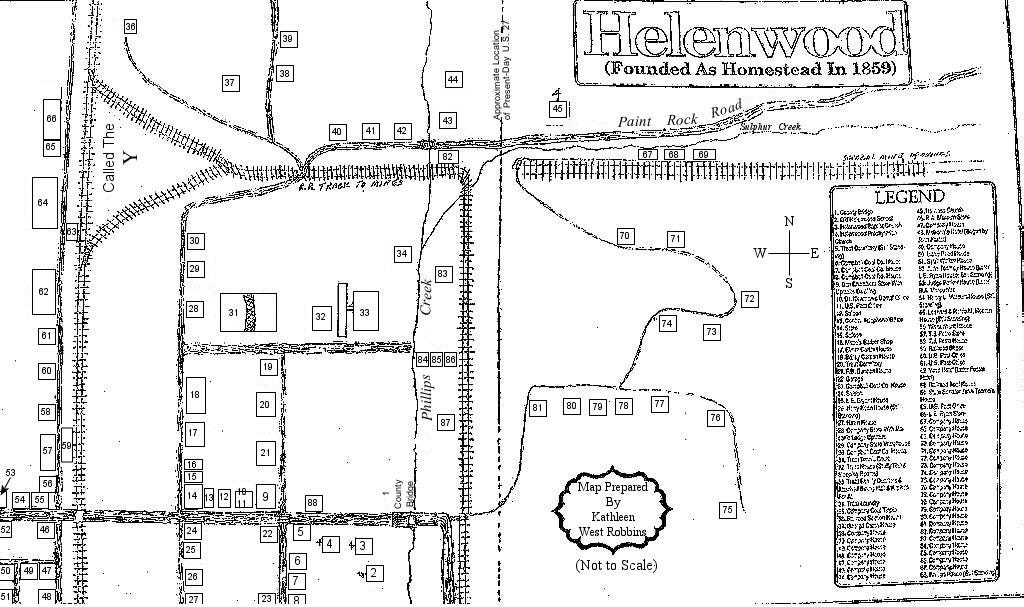
ORIGINS: The town of Helenwood actually predated the Southern Railroad. It began as Homestead in 1859. The town was surveyed on July 27 of that year, and laid out in 50-foot by 200-foot lots, according to Kathleen West Robbins, writing for the FNB Chronicle in 1991. She wrote that 90 of those lots were sold. The plots contained a spot for a school, a church, and a town square.
It was about this time that Helenwood Cut Cemetery was created. The first burial there occurred in 1855, and it was not called Helenwood Cut until later, after the railroad was built.
Although plans were made for the town well before the railroad, little is known about Homestead, and there is no record of anything noteworthy occurring there during the Civil War, which caused significant hardship in most other parts of Scott County, including notable events at No Business, Brimstone, Buffalo, Jellico Creek, Winfield, Huntsville, and elsewhere.
With the opening of the Southern Railroad in 1880, things changed. Helenwood quickly grew from a siding to a depot and a fledgling town, with stores and saloons. The town’s post office opened in 1880, the first store — owned by Ike Shoemaker — also opened in 880, and the town began to be called Helenwood. This new town had Scott County’s first newspaper: The Scott County Call.
It isn’t clear where the name came from. The National Park Service says that the name stuck after a dynamite explosion destroyed part of the town in 1935. However, newspaper records show it was called Helenwood as far back as 1881. Kathleen West Robbins offered competing theories: a Captain Wood had a daughter named Helen, and that it took its name from the saloon days (”Hell in the Woods”).
The earliest newspaper record of the name Helenwood is Dec. 25, 1881, when the Chattanooga Daily Times reported on the opening salvo of the Cecil-West-Smith Feud, which enveloped three branches of the same family and claimed several lives.
The first coal mines at Sulphur Creek opened in 1881, and were owned by Jim and John Pemberton. The Pemberton brothers sold to Fry & Co., which became Campbell Coal Company. There were as many as 40 company houses, and a railroad spur was built along Sulphur Creek to the mines, departing the Southern Railroad in a “Y” across from where Cumberland Wood Products is now located.
The Helenwood Presbyterian Church organized in 1883. The Baptists were meeting in the town’s school at the time. It was in 1906 that Helenwood Baptist Church was officially organized. The charter members were L.D. West, Ruth Wilder, John Moore, Denton Owens, and Alba Robbins. The first pastor was R.D. Ellis.
In 1912, a new three-room school was constructed just east of the existing school, which was sold to Helenwood Baptist Church for $50. It was used as the church until 1946, when a new church began to be built. It was completed in 1950. The Presbyterian church was later torn down, as well.
The mines continued into the 1900s, which was near the end of Helenwood’s heyday. The mines were reopened in the 1910s by Church Pemberton, James Baker, and other business partners, who founded the Ridgeway Sprinkle Co. After World War I, in 1919, there were still more than 150 miners working at the mines. The mines closed for good in the 1920s.
A dynamite blast destroyed part of the town on April 5, 1935. A warehouse where the dynamite was being stored, the old company store, the Masonic hall, and at least eight houses were destroyed. The dynamite was ignited by a house fire, which alerted the townspeople to the impending disaster and caused them to flee and avoid injury.
The Treat School for Boys, founded by Edward and Wilma Treat, began in 1910 and was housed in buildings formerly owned by the Campbell Coal Company.
Today, none of the original commercial buildings remain in Helenwood. The railroad still runs through what was once the old town, but trains do not stop there anymore. The depot has long since been torn down. Just about the only trace of “old Helenwood” is the Cut Cemetery on the outskirts of town, and Main Street, which runs from U.S. 27 to the railroad. However, most of the original roads through town can still be traced.
FIRST FAMILIES: Some of the early families of Helenwood included the Reeds, the McDonalds, the Keetons, the Sextons, the Wests, and the Cecils.
The Sextons: It would be close to impossible to pinpoint who the first person was to settle the area that would become Helenwood, but one of the first were Robert “Robin” Sexton (1809-1885) and his wife, Salina Keeton (1817-1855). Robin was the son of Timothy Sexton Jr. (1783-1850) and a grandson of Revolutionary War veteran Timothy Sexton Sr. of Brimstone. His mother is reported to be Nancy Ellis (1800-1860). However, this would be unlikely, as Nancy would have been only nine years old at the time of her son’s birth. Robin and his wife had several children, including Emmanuel, Artema West, Rebecca West, Christopher Columbus, Malissan West, Marion, and Martha Crain. Following Saline’s death in 1855, Robin remarried to Elizabeth Newport in 1864 and had several more children: Sylvania Petre, Ellana Phillips, Emley Bryant, and Simeon.
The Keetons: Salina Keeton (1817-1855), wife of Robin Sexton and believed to be the first person buried at Helenwood Cut, was the daughter of William Keeton Jr. and Artema Stevens (1786-1850). The Keetons settled along Phillips Creek north of what is now Helenwood, eventually spreading to the area around Scott County Airport, and to Tunnel Hill when one of them (Baty Keeeton) married into the Carson family that lived there. William Keeton Jr. (1786-1850) was the son of William Keeton (1758-1813) and Salina “Lina” Green (1764-1820) of Virginia. He and his wife migrated from Virginia to Tennessee after their marriage. Salina Keeton Sexton had a brother named Harrison Keeton (1818-1880) who married Elizabeth J. Reed (1818-1870) and had at least 12 children. It was Harrison who settled on Phillips Creek, and he was the father of Tunnel Hill’s Baty Keeton. The Keeton family still lives in Helenwood today. A road across the railroad from Helenwood Main Street is named Keeton Lane. Rick Keeton, a former mayor of Scott County, grew up there.
The Reeds: Elizabeth J. Reed (1818-1870), wife of Harrison Keeton, was the daughter of Isaac Reed (1790-1854) and Phariba Hatfield (1795-1865). The Reed family would eventually become quite prominent in the New River community to the south, but Elizabeth was born in Helenwood. Isaac Reed was originally from South Carolina, the son of John R. Reed and Nancy Morris. John and Nancy moved to the Demory area of Campbell County, east of LaFollette, in the late 1700s. Phariba, Isaac’s wife, was the daughter of Joseph Hatfield (1740-1832) and Rachel Smith (1758-1858). Joseph Hatfield was a Revolutionary War veteran who moved to present-day Scott County in the early 1800s and settled on Brimstone Creek. Isaac’s father was also a Revolutionary War veteran, though he never lived in Scott County. Isaac and Phariba were married in 1810 in Campbell County, and they had 15 children.
The McDonalds: Elihu McDonald (1852-1907) lived at Helenwood by the 1880s. He was the son of James McDonald(1813-1863), one of the many Scott Countians captured by Confederate forces at the Battle of Rogersville in 1863 who later died in a rebel prison. James McDonald was the son of Revolutionary War veteran James McDonald (1758-1848), who moved to Winona after the war. Elihu married Martha E. Ramsey (1861-1918) in 1876.
The Cecils: There is no name any more synonymous with Helenwood today than the Cecil family. James Timothy Cecil (1805-1871) married Phariba Reed (1810-1881), one of the daughters of Isaac Reed and Phariba Hatfield, after moving from Kentucky to Tennessee and settling in the Helenwood area. Virgil Cecil, James and Phariba’s great-grandson, served as pastor of Helenwood Baptist Church from 1937 until 1974. His son, Milford Cecil, later pastored the church for 10 years before leaving to take the same role at Paint Rock Baptist Church. When Milford left, his brother, Roger Cecil, took the pastorship and pastored for 33 years until his declining health forced him to retire. Together, Virgil Cecil and his sons pastored Helenwood for an astounding 80 years. Virgil Cecil’s father, Reuben Churchwell “Rube” Cecil, was also a preacher. And Rube’s brother, George Washington Cecil, was one of the most prominent preachers in Scott County’s history. He was the first pastor of First Baptist Church of Oneida, and preached the funeral of Mike King, the only Scott Countian to ever be legally hanged, from the gallows in Huntsville.
The Cecils were also at the center of the tragic Cecil-West-Smith Feud that began on Christmas Eve in 1881 at one of Helenwood’s saloons. Seventeen-year-old John Wesley Cecil — brother to preachers Rube and George W. Cecil — was shot and killed by his uncle, Robinson Crusoe West. The Cecil family, led by John Wesley Cecil’s father, William Cecil, avenged his death by killing Crusoe West. But John Wesley’s 24-year-old brother, Reason Burl Cecil, was killed in the melee. Later, in 1883, another branch of the family, the Smiths, killed John Wesley’s 27-year-old brother, William Riley Cecil Jr., and badly wounded William Cecil, who survived. Following Riley’s death, his wife, Lucinda Thomas, married Maynard Harrison Keeton.
The Wests: Nancy Williams West Cecil (1833-1900), the wife of William Cecil and the mother of John Wesley, Riley, Rube, George and at least nine other children, was the daughter of Reuben West (1810-1883) and Emily Clemons (1811-1872). Robinson Crusoe West was her brother. She and William Cecil married in 1848. Reuben West was the son of Charles P. West (1778-1860) and Sarah “Sally” Phillips (1788-1860). He later married Elizabeth “Betty” Ellis. He and Emily Clemons had at least eight children. Charles West and Sally Phillips were married in 1803 in Greene County, Tenn. They had at least nine children, including Reuben.
The Phillips: Remember that the main stream through Helenwood was named Phillips Creek. The Keeton family settled on this stream. It was named for Thomas Phillips (1768-1841) and Mary Goad, the parents of Sally Phillips, who married Charles West. Thomas Phillips was originally from Virginia but moved to Tennessee. His father was Revolutionary War veteran William Tobias Phillips. Thomas came to Tennessee with a brother, Joseph Phillips, who married Elizabeth Lawson — daughter of Revolutionary War veteran Randolph Lawson — and settled on Paint Rock Creek, and his father-in-law, Revolutionary War veteran Abraham Goad.
MAJOR HISTORICAL EVENTS: Helenwood was the site of several murders during its heyday. According to a list compiled by James B. Phillips and given to Critt Phillips in the 1950s (and later provided to James Toomey Baker, who provided it to Don C. Stansberry Jr.), the following murders took place in Helenwood:
• Jake Daniel, a bartender, was killed by John Terry in Strunk’s Saloon.
• John T. Pemberton killed John Paul.
• William Washington Cecil killed Jerry West.
• Jim Phillips killed As Byrd.
• Ticket Wes Owens killed Jim Phillips in Walker’s Saloon.
• Harvey Phillips cut Jim Phillips’ throat the same day Jim was killed.
• Fount Phillips killed a black man at the railroad crossing — “shot him in back just to see him jump.” Phillips was a law enforcement officer and the black man was a “strike breaker” at Robbins.
• Charlie Davis killed Jim Hammock on July 4, 1922, behind the railroad depot. Davis was later killed at Stearns, Ky. by Windy Marion Phillips, who died in prison.
• Alfred Cecil was killed in a field while plowing.
• Dave Hill was killed by an unknown person.
• Henry Potter and Alvin Parker killed an unknown man in a saloon. He was buried in a creek across from the spring in about 1880.
• The Cecil-West-Smith Feud of 1881-1883 involved the deaths of John Wesley Cecil by Crusoe West, Burl Cecil by Crusoe West, Crusoe West by several members of the Cecil family, and Riley Cecil by several members of the Smith family.
• Dan Toomey killed Louis Sexton on July 4, 1888, in Strunk’s Saloon. Dan was later killed by his brother, Jim Toomey, in Glenmary.
• John Potter killed his son-in-law, Alvin Parker, by shooting him from an upstairs window about 1890.
• John David killed Andy Adkins and “a Newport man” in Pemberton’s saloon.
• John David, Frank Hughett, and Hughett’s wife killed Louis and Jim Pemberton in front of the depot.
• Albert Hurtt killed Bill Walker.
• Scott Keeton killed Maynard Cecil.
• Press Wilder killed Fowler Keeton.
• Carl Waters killed a man named Wilson.
• Lindsay Phillips killed “a Keeton boy.”
• Lige Taver was killed by an unknown person.
• Judge James Fulton killed Sam Parker on the railroad depot. Fulton was later killed by a newspaper editor.
• Hobert Phillips killed Caney Brown.
• Mitchell Phillips killed Fount Phillips.
• A “Reed boy” killed Roebuck Phillips with “bolt on stick.”
• Earl Claxton killed Harry Foster.
On March 3, 1925, a passenger train derailed at Helenwood, killing two people as the train was being moved to a side rail.
On Jan. 24, 1931, a passenger train — the Suwanee River Special — derailed just south of Helenwood, killing three passengers and two crew members, while injuring 10 others.
On April 5, 1935, a dynamite explosion destroyed several of the buildings in town. No one was injured.
Helenwood was also home to the “Scott County Devil” in the 1920s.
Thank you for reading. Our next newsletter will be Threads of Life tomorrow. If you’d like to update your subscription to add or subtract any of our newsletters, do so here. If you haven’t yet subscribed, it’s as simple as adding your email address!
◼️ About the IH • IH Sports Network • The Encyclopedia of Scott County
◼️ Subscribe • Sponsor • Manage Your Account
◼️ Follow us on Facebook, Instagram, X/Twitter, YouTube
Our Newsletters:
• Monday morning: The Daybreaker (news & the week ahead)
• Tuesday: Echoes from the Past (stories of our history)
• Wednesday: Threads of Life (obituaries)
• Thursday evening: The Weekender (news & the weekend)
• Friday: Friday Features (beyond the news)
• Sunday: Varsity (a weekly sports recap)