


You’re reading “Echoes in Time,” a weekly newsletter by the Independent Herald that focuses on stories of years gone by in order to paint a portrait of Scott County and its people. “Echoes in Time” is one of six weekly newsletters published by the IH. You can adjust your subscription settings to include as many or as few of these newsletters as you want. If you aren’t a subscriber, please consider doing so. It’s free!
Today’s newsletter is sponsored by the Scott County Chamber of Commerce. Since 1954, the Scott County Chamber of Commerce has advocated for a strong community by supporting stronger infrastructure and leadership.

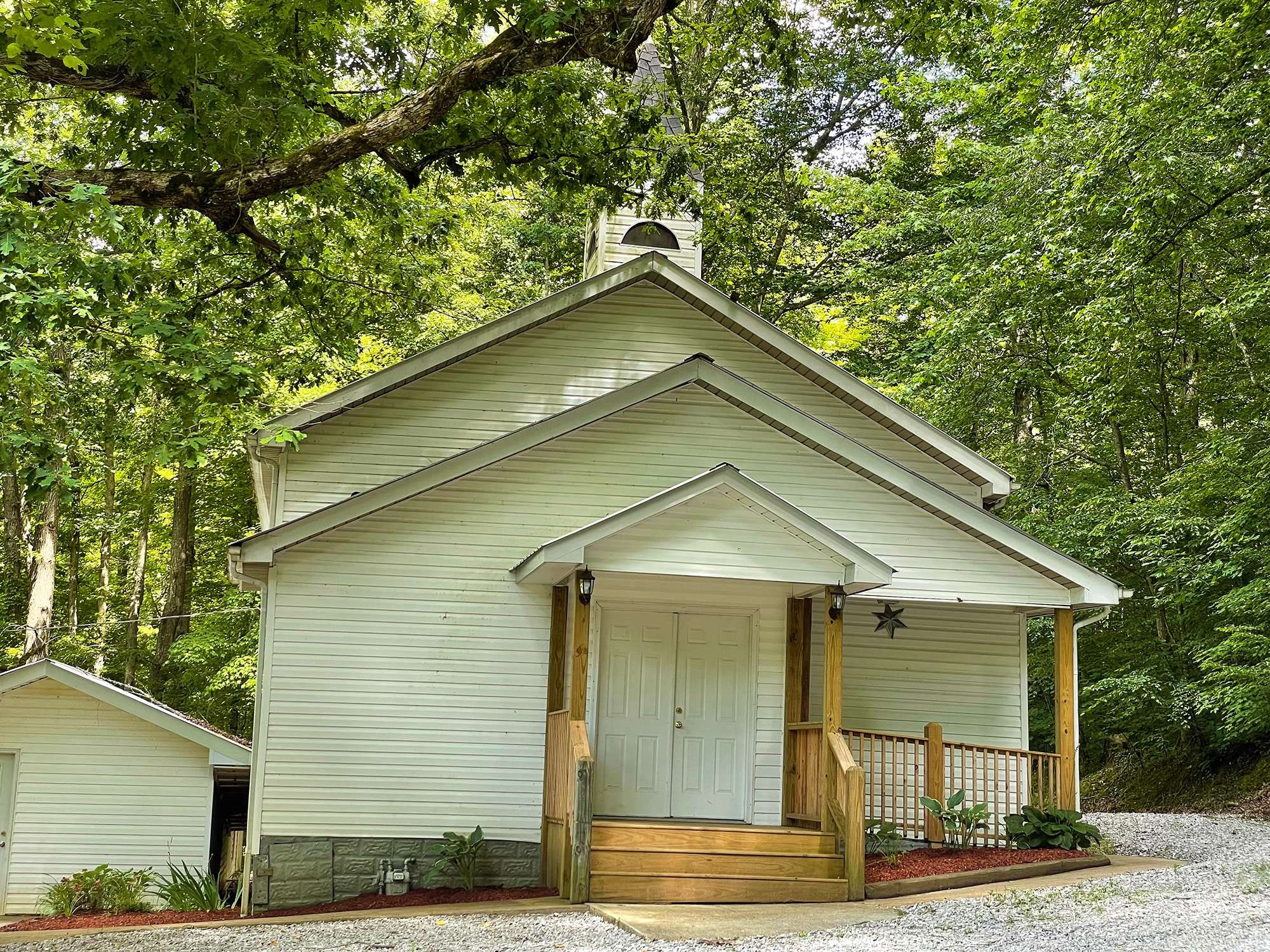
Scott County’s communities: Gum Fork
As Echoes in Time continues its look at Scott County’s various communities through the years, we move on this week to the Gum Fork community east of Winfield.
Winfield, of course, was one of the earliest settlements on the northern Cumberland Plateau, when Revolutionary War veteran James Chitwood moved his family there from North Carolina. Others followed, and settlement quickly spread to the remote fertile stream valleys deeper in the mountains — like Gum Fork, Jellico Creek, and Capachene.
Today, those settlements have largely disappeared. Gum Fork, which is located across Chitwood Mountain from Pleasant Grove, along Gum Fork Creek, is still just as settled as it ever was, but there are only a handful of folks living in the communities beyond at Jellico Creek and Capachene.
For the purposes of this profile, all three of these communities will be considered part of Gum Fork. There was a time, though, when all of these were distinct settlements. From Alderville and Pleasant Grove (which was named for Pleasant Chitwood, one of the sons of James Chitwood), the road crossed Chitwood Mountain and dipped into the Gum Fork Valley, which served as a gateway to Angel Valley (named for the Archibald Angel family that settled there) located along Jellico Creek. Then there was Upper Jellico Creek, settled by the Trammells and others, and, across Dennis Ridge, Capuchine Creek.
Gum Fork was traditionally called Ketchen, as well.
POST OFFICES: The Gum Fork Post Office opened in March 1884 with George W. King serving as postmaster. It closed in September 1893 and moved to Isham, which was located northeast of Winfield. William Trammell was the last postmaster at Gum Fork. (Isham, meanwhile, closed in September 1926 and moved to Winfield. Its last postmaster was Hubert Trammell.)
There was also a post office at Capuchin (or Capachene; the spellings vary). It opened in October 1882 with Hiram Trammell serving as postmaster. It closed in May 1914 and moved to Newcomb, which is located further east in Campbell County.
Today, the entire Gum Fork area is served by the Winfield Post Office and is part of the 37892 zip code.
SCHOOLS: Historically, one-room schools were scattered throughout these mountain valleys. By 1935, schools that were in operation included Gum Fork Mountain, as well as Jellico School at Ketchen, Honeycutt and Chitwood Mountain to the west, Lower Capuchin and Upper Capuchin to the east, and Baird Creek and Adkins to the north (Adkins was located across the mountain at Pine Grove). One of the old school buildings, the one at Ketchen, is still partially standing and can be viewed on the right side of the road just before the Jellico Creek crossing.
Today, students from the Gum Fork area are zoned to Winfield School for grades K-8 and Scott High School for grades 9-12.
CHURCHES & CEMETERIES: The Gum Fork community was traditionally served by Gum Fork United Baptist Church. More recently, a split in the church led to the establishment of the Gum Fork Community Baptist Church across the road. There is also the Zion Baptist Church at Ketchen. Several miles southeast on Jellico Creek is the Upper Jellico Creek United Baptist Church.
There are a number of small cemeteries spread throughout these mountain valleys, the largest and oldest of which is the Angel-Wright Cemetery at Angel Valley. Among the others are the Ryan Cemetery at Gum Fork, the Trammell Cemetery and Adkins Cemetery on Jellico Creek, the Chitwood Cemetery at Upper Jellico Creek, the Trammell Cemetery at Capuchin, and still others.
COMMERCE & BUSINESS: This has never been a business community. Rather, it has always been made up of small farms and residences. The most productive farm, historically, is Angel Valley, located near Ketchen, where Gum Fork Creek empties into Jellico Creek. In the mid 20th century, coal mining was prevalent in the hills surrounding Gum Fork. More recently, the timber-cutting industry has been a major activity. Fun fact: there was a “camp” of sorts located at the upper end of Jellico Creek, that was once utilized by the Oneida High School football team during the summer. Those old buildings still stand (on private property).
FIRST FAMILIES: The first families to settle at Gum Fork included the Angels and the Trammells, who were connected, and then others.
The Angels and Trammells: Archibald Angel (1775-1847) married Nancy Ann Trammell, the daughter of Revolutionary War veteran Dennis Trammell (1759-1849), in about 1804. It is not known exactly when the two families arrived in present-day Scott County, but it appears to have been between 1807 and 1810. Court records indicate that Dennis Trammell was living in Knox County, Ky., in 1805. One year earlier, in 1804, Col. Return Jonathan Meigs sent a letter naming Archibald Angel and others as “intruders on Indian Lands on the West Side of the Cumberland Mountain.” It is not clear exactly where Angel lived at the time. Meigs’ letter ordered them to remove themselves or be forcibly removed by the U.S. military. In 1807, Angel and Trammell both appeared on a tax list in Knox County, Ky.
By 1810, survey records indicate that Angel owned 298 acres of land on Pine Creek, while Trammell owned 216 acres of land on Pine Creek. At that time, the entire Oneida area was known as Pine Creek. However, what the records don’t make clear is whether the property owned by Angel and Trammell was actually in Oneida, or if Jellico Creek was part of a larger area that was still broadly referred to as Pine Creek.
Either way, both families eventually wound up at Jellico Creek, settling the lush valley that would become known as Angel Valley.
Dennis Trammell was first married to Elizabeth Brassfield. He later married Martha Cooper.
James Trammell, a brother of Nancy Trammell Angel, died in 1826 and was buried on a small knoll at Angel Valley that would come to be known as the Angel-Wright Cemetery. His is the oldest original identifiable headstone found in Scott County.
When Nancy Trammell Angel died, Archibald remarried to James Trammell’s daughter, his niece. He had a total of at least 11 children — six with Nancy and five with Charlotte Trammell.
Angel was one of the few slaveholders in Scott County, indicating that he was relatively wealthy. He owned five slaves in 1830 and seven slaves in 1840.
Archibald Angel died in 1847 and it is believed that he was buried in the Angel-Wright Cemetery, though he does not have an identifiable headstone. Dennis Trammell died in 1849 and was buried at Trammell Cemetery near Pine Grove.
As years passed, the Angel surname disappeared from these mountain valleys, while the Trammell surname thrived. As previously mentioned, William Trammell served as a postmaster at Gum Fork and Hiram Trammell at Capuchin, while Hubert Trammell was a postmaster at nearby Isham. And there are Trammell cemeteries located both on Jellico Creek and Capuchin Creek.
Hiram Trammell was a grandson of Dennis Trammell (son of David Trammell and Lucinda Holt).
William Trammell was a great-grandson of Dennis Trammell (son of another Dennis Trammell and Mary “Polley” Baker). The latter Dennis Trammell was one of the children of James Trammell (whose headstone is the oldest original identifiable stone found in Scott County) and Rachel Starks. He served as a captain in the Union army during the Civil War, and his Jellico Creek home was burned by Confederate soldiers during a raid.
So why did the Angel surname disappear from these valleys while the Trammell surname thrived? Part of it was due to coverture — the old English common law that was carried to America and remains widely practiced today, wherein a woman takes her husband’s name. Arch Angel had at least 11 children, but most of them were daughters. His only sons were James Angel, Dennis Angel, and John Angel. James made up for that after he married Sarah “Sally” King in 1830. They had six sons: Thomas, Lewis Sevier, William, Archibald, Nimrod, and James Jr. However, a number of them left Angel Valley and moved to McCreary County, Ky. Dennis Angel had several sons with his second wife, but several of them died as babies or young children.
The Kings: William King (1785-1841) was born in what is now Washington County, Tenn., and later moved to present-day Scott County with his wife, Elizabeth. They’re both believed to be buried at Angel-Wright Cemetery. Thomas Murray King, William’s brother, made the move to Scott County with them. His son, Jackson King, married Archibald Angel’s daughter, Elizabeth Jane. This was the start of the King family that remains prominent in northern Scott County today.
The Blankenships: Camilla Blankenship (born about 1830) was the daughter of Archibald Blankenship and Sarah Richardson. She had a child outside of wedlock with Dennis Trammell, named Ewell Blankenship. His second wife appears to have been Lucinda Trammell, one of Dennis Trammell’s great-granddaughters. Archibald and Sarah were buried about 1816 in North Carolina, after which they moved to the Gum Fork area, settling at Capuchin. In addition to Camilla, they had at least six other children, including William Burwell Blankenship and Canada Blankenship, along with several daughters. William left Scott County for Missouri. Canada remained at Capuchin. He married Malinda Trammell, one of the daughters of James Trammell and Rachel Starks, and they had at least nine children: Jane, James Dennis, William Riley, Sarah Ann, Daniel, Henderson Canada, Abraham Lincoln, John Canada, and John Cicero.
The Bakers: One of the more prominent early families at Capuchin was the Baker family. Mary “Polley” Baker (1811-1873) was the daughter of Samuel Baker. She married Dennis Trammell (1815-1891), a grandson of the original Dennis Trammell. She was blind. As mentioned previously, their home was burned by Confederate soldiers in 1863, while her husband was away at war. The soldiers led her from her home before torching it, and the family was forced to spend the winter that followed in a nearby cave.
Samuel Baker was commissioned as a lieutenant in the Campbell County militia in 1809, and was later elected the first coroner of Campbell County. He lived on Jellico Creek, which would become part of Scott County in 1849. His wife’s name is unknown. Besides Polley, other children included David, Robert Clay, Malen Samuel, Clary, and Sarah.
The Wrights: The Wright family married into the Angel family. Dennis Wright (1858-1925) and his son, Lewis, married Angel cousins. Dennis married Lucinda Angel, a great-granddaughter of Archibald Angel. Two of Lucinda’s sisters married Wrights, as well. Salena Jane’s second husband was Andrew Johnson Wright, and Sarah Ann married Henderson Canada Wright.
The Bairds and Longs: Further east, on Capuchin, early families included the Bairds and the Longs, in addition to the Trammells. Henry Long was the first husband of Lucinda Trammell, who later married Ewell Blankenship. Travis Baird, the son of Samuel C. Baird and Anna Doelin and one of 17 siblings, married Dinah Trammell. Lucinda and Dinah were the daughters of Hiram Trammell, the first postmaster at Capuchin. Following Travis’s death, Dinah remarried to Litt Rains in 1879. Travis had a brother, William, who married Sarah Trammell. She was the daughter of Dauswell Trammell and Chloe Hamby.
The Ryans: Joseph Ryan, born in 1787 in Virginia, married Martha Evelyn Holt (1794-1852) in 1808. Her parents (Drury Holt and Sara Rogers) lived just across the state line at Little Rock Creek. Martha’s sister, Lucinda Holt, married David Trammell. Joseph and Martha had children that included David, Drew, Joel, Malinda, Martin, Moses, and Cornelius. Moses (1839-1901) was the only one who remained at Gum Fork. He married Sarah Smith (1844-1924) and served in the Union army during the Civil War. Their children included Elizabeth, Martha, Joseph, Tennessee, Octavia, Arminda, James, William, Elizabeth, and Lee. Arminda married into the Angel family, marrying John Leslie Angel in 1895. He was a great-grandson of Archibald Angel.
The Lays: Michael Lay and Elizabeth Lay lived briefly on Jellico Creek before later moving to McCreary County, Ky. They were from the same branch of Lays who moved into the Rock House area of Scott County from Pioneer. Elizabeth was a granddaughter of “Missouri Jack” Lay. Michael had a brother, William Paris Lay, who married Lucy Robinson and also moved to the Jellico Creek area.
The Maxeys: Goldie Ryan, the daughter of Mark and Elizabeth Ryan, married James Oscar Maxey, the son of John Maxey and Mary Childress. That was the start of the Maxey family at Gum Fork.
Thank you for reading. Our next newsletter will be Threads of Life tomorrow. If you’d like to update your subscription to add or subtract any of our newsletters, do so here. If you haven’t yet subscribed, it’s as simple as adding your email address!
◼️ About the IH • IH Sports Network • The Encyclopedia of Scott County
◼️ Subscribe • Sponsor • Manage Your Account
◼️ Follow us on Facebook, Instagram, X/Twitter, YouTube
Our Newsletters:
• Monday morning: The Daybreaker (news & the week ahead)
• Tuesday: Echoes from the Past (stories of our history)
• Wednesday: Threads of Life (obituaries)
• Thursday evening: The Weekender (news & the weekend)
• Friday: Friday Features (beyond the news)
• Sunday: Varsity (a weekly sports recap)