


You’re reading “Echoes in Time,” a weekly newsletter by the Independent Herald that focuses on stories of years gone by in order to paint a portrait of Scott County and its people. “Echoes in Time” is one of six weekly newsletters published by the IH. You can adjust your subscription settings to include as many or as few of these newsletters as you want. If you aren’t a subscriber, please consider doing so. It’s free!
Today’s newsletter is sponsored by the Scott County Chamber of Commerce. Since 1954, the Scott County Chamber of Commerce has advocated for a strong community by supporting stronger infrastructure and leadership.

Scott County’s communities: Buffalo
This week, we continue our “Echoes in time” series’ profiles of Scott County’s communities with a look at Buffalo — the fertile bottomlands of Buffalo Creek and Smith Creek, which housed one of this area’s earliest settlements.
It’s hard to know exactly when the first permanent white settlers cleared land and built cabins along the northern Cumberland Plateau’s waterways. All we have to go by are early tax lists and land deeds, and those are listed in other counties, since Scott County wasn’t formed until 1849. Traditionally, the Smokey Creek community is viewed as being Scott County’s truly first settlement, and there’s no concrete evidence to refute that. But Buffalo was certainly close behind, along with Brimstone, New River, No Business, and Black Wolf Creek (near Glenmary and Elgin).
This much is indisputable: To the first adventurers wandering through the Cumberland Gap and looking to stake out a livelihood in this frontier land, there was no better land to be found between the Cumberland Mountains and the Big South Fork River than Buffalo. The wide, fertile bottomlands were unmatched, and an old Indian trail followed the creek itself, serving as one of the earliest roads through the region.
In fact, Buffalo was perhaps the most prominent Scott County community at the time of the Civil War. And when Scott County was established a decade before the war, county leaders considered making Buffalo the county seat before they eventually settled on the area that we now know as Huntsville.
As a general rule, the Buffalo community can be described as the area between Pine Hill on the east end and Annadale on the west end. Buffalo Creek’s headwaters are located on the “back side” of Pine Hill, and the stream follows Buffalo Road to just east of Smith Creek, where it turns and flows through the Sugar Grove community before crossing S.R. 63 and flowing through mostly undeveloped land to New River near Winona. Besides Smith Creek, major tributaries include Stanley Creek and Rockhouse Fork.
Today, Buffalo remains much the same as it was when the first white men began to settle here more than 220 years ago. There are more homes now than there were then, and they’re fancier, the roads are paved and traveled by automobiles instead of horses, and the virgin timber is long gone while cleared farmlands cover most of the valley that isn’t marked by residences. The residents leave the valley to work jobs now, rather than living a lifestyle of subsistence off the land itself. But it’s still a quiet residential community that never developed into a full-fledged town.
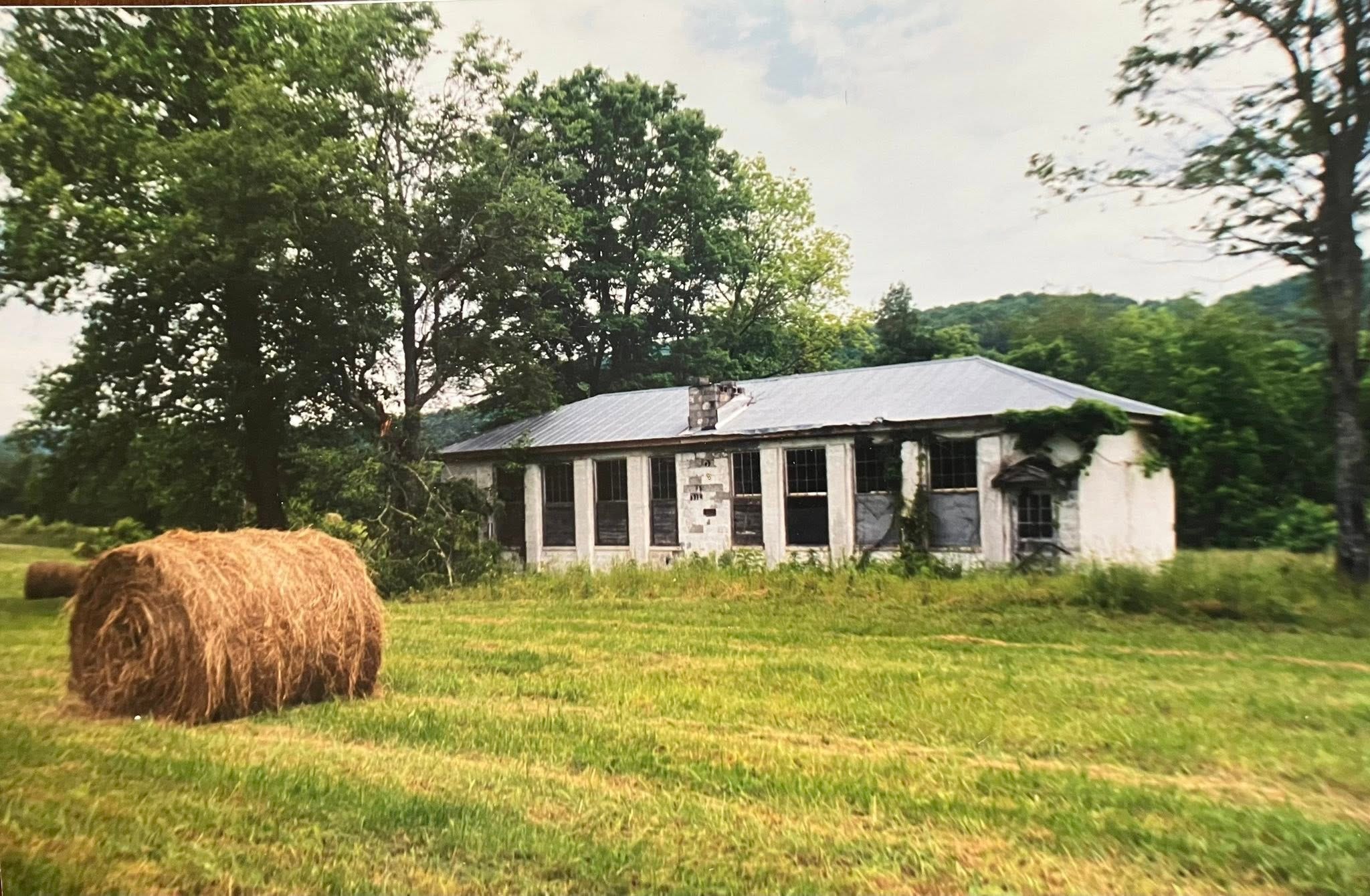
SCHOOLS: Today, the Buffalo community is zoned for Huntsville Elementary School and Middle School, or Fairview Elementary School. Historically, however, several small schoolhouses dotted this landscape. There were schools at Smith Creek, Black Gum, and Sugar Grove, as well as Buffalo School, which was located near where Smith Creek empties into Buffalo Creek and stood until the early 2000s, when it was destroyed by fire. Further north were the Arches Creek School and Posey School.
BUSINESS & COMMERCE: There are no major businesses at Buffalo today, though there have been some smaller businesses located here through the years. Most notably, Civil War veteran John Fetterman — who marched through Scott County as part of Burnside’s invasion in 1863 — returned to Scott County in his latter years and settled on Smith Creek, where he established a factory that made wooden bowls. He opened the community’s first post office in the 1890s, and it was named “Bowl,” after his factory. The bowl factory was located near New Salem Baptist Church.
CHURCHES & CEMETERIES: There are a number of churches dotting the Buffalo community. Where Stanley Creek empties into Buffalo Creek is the Mt. Zion United Baptist Church. Further north, towards Pine Hill, is Salem Baptist Church. Although it isn’t traditionally considered part of the Buffalo community, Pine Hill United Baptist Church is located along Buffalo Road near the Pine Hill crossroads. At Smith Creek is the New Salem United Baptist Church. In the Sugar Grove neighborhood is the Sugar Grove Missionary Baptist Church. On the hill above it is Five Black Gums United Baptist Church. Finally, where Sugar Grove Road meets Old 63 is the Buffalo Bridge Missionary Baptist Church.
There are several small cemeteries throughout Buffalo. Most notable, perhaps, is the Lloyd Cemetery, which is located on the hill overlooking New Salem United Baptist Church, or the Laxton Cemetery, which is located closer to Annadale. However, there are many more, and each of them have rich history.
BUFFALO IN THE CIVIL WAR: As previously noted, Buffalo was perhaps Scott County’s most prominent community at the time of the Civil War, and it was a community that was indelibly changed by the war.
Smith Creek was home to Hiram Marcum, a Union loyalist who served as a pilot to help other loyalists from East Tennessee slip northward into Kentucky to join the federal army. For that, he was targeted by Confederate forces, and the result was the infamous skirmish at his Buffalo farm in September 1861. His 16-year-old daughter, Julia Marcum, lost an eye and a finger defending her family and her home in that fight. Some months later, in January 1862, Confederate troops returned to the Marcum farm, where they shot and killed Julia’s first cousin, George Marcum. He was enlisted in the Union army but was home on leave. The second incident prompted the Marcum family to flee Buffalo. Hiram joined the Union army, and his wife and children moved north into Kentucky. Hiram contracted smallpox and died in Nashville before the end of the war.
Later in the war, a regiment of Confederate pillagers murdered two Buffalo men and left their bodies hanging in a fruit orchard. Their victims were Larkin Cross and Ranson Vanover. Vanover was enlisted in the Union army, but Cross was not. A group of rebel Scott Countians who had helped to form the Scott County Rangers were indicted for the murders after the war, but they fled Scott County and never stood trial. Both Cross and George Marcum are buried at the Lloyd Cemetery near New Salem United Baptist Church.
Several other incidents occurred at Buffalo during the war, including the murder of a Confederate soldier who was attempting to return home after the war and was shot along the main road through the Rock House community, which continued east to Jacksboro.
After the war, outlaws Jesse and Frank James visited Scott County under assumed names. It was said that the Marcum family that remained at Buffalo — Hiram’s brother, George Marcum, and his family — stabled the James brothers’ horses. A ravine along Marcum Creek, which empties into Smith Creek, has long been known to locals as “Horse Lot Hollow.” After George and his wife died, according to the historian Esther Sharp Sanderson, grave-robbers dug up their coffins, believing that gold given to them by the James brothers had been buried with them.
FIRST FAMILIES: In her book, County Scott and Its Mountain Folk, historian Esther Sharp Sanderson wrote that the first two settlers to arrive at Buffalo were Isham Sharp and Thomas Chambers. The men “left their wagons at LaFollette and came through with their families and cattle and with horses carrying their belongings,” she wrote. “They made several trips back and forth before they finally got their meager possessions over the mountain trails to the present site of Buffalo.”
Thomas Laxton was another early settler of Buffalo. Sanderson wrote: “Thomas Laxton, with all his worldly possessions on his back, trudged on foot carrying two hound pups and some fruit trees to Smoky, from North Carolina. He later moved to Buffalo, where he married and reared a large family.”
The patriarch of the Chambers family at Buffalo was actually Thomas Chambers’ father, Revolutionary War veteran William Chambers (1750-1840). Family legend has it that he was captured by Indians during the war and taken to Arkansas, where he learned the customs of the natives and was accepted as one of them, and given the nickname “Walkingstick” (Da-Sti-Sti). The legend says that he married an Indian woman named Tar-Chee-See. They had five children, including Thomas, who married the daughter of another Revolutionary War veteran, Randolph Lawson. Thomas and Katie had at least 13 children. One of them, James Riley Chambers, was on the committee that chose Huntsville as the county seat after Scott County was established in 1849.
William, Thomas and Katie, and many other members of the Chambers family are buried at the Chambers Cemetery, which is located next to where the old Buffalo School once stood.
Isham Sharp may have accompanied the Chambers family when they moved to Buffalo, but the records are inconclusive. Sorting through the broken records trail, it appears that Isham Sharp was born in North Carolina in 1780, and married Sarah Martha Joyce in 1805. They had at least eight children. Making the move to Tennessee with Isham Sharp was likely his brother, James Sharp (1782-1843), and perhaps another brother, Richard Nicholas Sharp Jr. (~1775-1823). It has also been suggested that their parents, Richard Nicholas Sharp Sr. and Elizabeth Sharp, made the move to Buffalo with them.
James Sharp’s son, James L. Sharp (1816-1893), settled in Winfield and became Scott County’s third sheriff. James L.’s parents did not settle at Buffalo, but instead lived in the Buckeye area of Campbell County, near present-day Pioneer. His son, Nicholas Sharp, built the two-story motel in Winfield that became known as the Hines Motel. Unfortunately, there’s nothing to conclusively place the Sharp family at Buffalo, though Isham Sharp certainly lived in Scott County
Besides the Chambers family, one of the most prominent families at Buffalo through the years has been the Laxton family. Thomas Laxton (1795-1862), mentioned by Sanderson in her book, was the first to make the move, and was likely on the scene by 1814, when he enlisted in the East Tennessee Militia at Knoxville as a substitute for James Isom. Laxton married Elizabeth Goad (1800-1881) and they had several children, including Alfred (1821-1892), John “Jackie” (1830-1918), Thomas Jr. (1840-1923), Levi (1843-1864), and likely others.
Esau Laxton (1884-1956) was a Scott County sheriff in the 1920s and 1930s. He was a great-grandson of Thomas Laxton, the son of Isham “Sharp” Laxton (1865-1941). His son, Jack O. Laxton (1923-2002), also served as sheriff of Scott County. Jack Laxton’s son, Darryl Laxton, is a long-time chief of police in Oneida. He is a third-great-grandson of Thomas Laxton. Esau Laxton’s father, Isham Laxton, was called Sharp because that was his mother’s maiden name. John Jackson Laxton married Amanda “Millie” Sharp (1822-1914). She was the daughter of Isham Sharp and Sarah Joyce — providing the clearest evidence that Isham Sharp did, indeed, settle at Buffalo. The Laxton Cemetery at Buffalo contains more than 200 graves.
Then there are the Marcums. No examination of Buffalo’s first families would be complete without a study of the Marcum family, for whom Marcum Creek is named. Marcum Creek empties into Smith Creek. Hiram Marcum, the Buffalo farmer whose home was attacked by Confederate soldiers in 1861, was the son of Arthur Markham III (1757-1832) and Anna Bransgrove (1851). His parents had apparently already settled at Marcum Creek when Hiram was born in 1812. There are two branches of Marcums in Scott County, and both are descended from Arthur Markham III and Anna Bransgrove. John Arthur Marcum, Hiram’s brother, settled the Pine Creek area near Oneida. John Arthur’s son was George Marcum, Hiram’s nephew who was murdered by Confederate soldiers at the Marcum Creek farm in 1862.
Hiram and John Arthur also had another brother, also named George Marcum, who lived at Marcum Creek near Hiram. It was he and his wife, Mary Ann Hanks, who are said to have kept the horses of outlaws Jesse and Frank James when the James brothers were staying in Scott County under assumed names shortly after the Civil War.
It isn’t clear where Arthur Markham and his wife, Anna, are buried, but it may be in unmarked graves at the Marcum Cemetery on Marcum Creek. While descendants of the Chambers and Laxtons can still be found at Marcum Creek today, the Marcums left long ago.
Smith Creek, which empties into Buffalo Creek, takes its name from Drewry (or Drewery) Smith. Born 1794, he was the son of William Smith and Suzan Lampkin, and was a veteran of the War of 1812. Smith had several children, including: Drewery (or Drury) Smith Jr., Kisiah Smith, Jane Smith, Jackson G. Smith, William F. Smith, Henry C. Smith, and John Smith.
According to historian H. Clay Smith, a descendant, in his book, Dusty Bits of the Forgotten Past, Drewery Smith and another Scott Countian, Sam Walker, participated in the movement of the Cherokee to Oklahoma, known as the “Trail of Tears.” At some point along the route, according to Smith, Drewery Smith and Walker became disgusted with the treatment of the Indians and began helping some of them escape.
Drury Smith Jr. lived at Smith Creek, along with other members of his family, during the Civil War. While Drury Smith was neutral, his nephew, Ewell Smith, was staunchly pro-Confederacy. He was a deputy sheriff in Scott County, and had served as postmaster at Straight Fork. His father, Drury Smith’s brother, John Lampkin Smith, had served as Scott County’s first circuit court clerk. John Smith’s wife was Keziah Gibson, and the Gibson family were strong Confederate sympathizers. Ewell Smith helped found the Scott County Rangers, a pro-Confederacy group, and was among the 17 men indicted by a grand jury for murdering Ranson Vanover and Larkin Cross at Buffalo in 1862.
The historian H. Clay Smith wrote that Ewell Smith’s brother, Callie Smith, was home on leave from the rebel army and was ambushed by the Scott County Home Guard, the pro-Union counterpart to the Scott County Rangers. As Smith attempted to reach Drury Smith’s home at Smith Creek, the historian wrote, he and others in his company encountered Vanover and Cross, and hanged them.
The Duncan family settled on Stanley Creek, which empties into Buffalo Creek just north of Smith Creek. The first to settle there was Civil War veteran Joshua J. Duncan (1833-1909). He was the son of Champion C. Duncan (1806-1904), and married Mary Sintha Cross (1831-1888). Later, following Mary’s death, he married Harriet Cross, the daughter of Larkin Cross, who was murdered during the Civil War.
Another of the Duncan clan was Oliver Duncan, who was present with Larkin Cross and Ranson Vanover when they were killed, but managed to escape. Duncan married Joshua J. Duncan’s sister, Rutha, who was his cousin. Larkin Cross married Oliver Duncan’s sister, Henrietta Clara Duncan.
Finally, the Cross family. Larkin Cross was the son of Louis Micajah Cross (1780-1846) and Lovis Duncan (1799-1887). Micajah and Lovis had at least six children. The oldest was Caswell Cross (1822-1893), whose farm was raided by Confederate soldiers the same day Larkin was killed. Micajah Cross was born in Maryland before the Cross family moved to Tennessee. His father, William Cross (1762-1833), made the move to Tennessee with his family. He settled in the Oak Ridge area of Anderson County. Exactly when the family moved to Tennessee isn’t certain, but it was probably between 1823 and 1825.
Thank you for reading. Our next newsletter will be Threads of Life tomorrow. If you’d like to update your subscription to add or subtract any of our newsletters, do so here. If you haven’t yet subscribed, it’s as simple as adding your email address!
◼️ About the IH • IH Sports Network • The Encyclopedia of Scott County
◼️ Subscribe • Sponsor • Manage Your Account
◼️ Follow us on Facebook, Instagram, X/Twitter, YouTube
Our Newsletters:
• Monday morning: The Daybreaker (news & the week ahead)
• Tuesday: Echoes from the Past (stories of our history)
• Wednesday: Threads of Life (obituaries)
• Thursday evening: The Weekender (news & the weekend)
• Friday: Friday Features (beyond the news)
• Sunday: Varsity (a weekly sports recap)