


You’re reading “Echoes in Time,” a weekly newsletter by the Independent Herald that focuses on stories of years gone by in order to paint a portrait of Scott County and its people. “Echoes in Time” is one of six weekly newsletters published by the IH. You can adjust your subscription settings to include as many or as few of these newsletters as you want. If you aren’t a subscriber, please consider doing so. It’s free!
Today’s newsletter is sponsored by the Scott County Chamber of Commerce. Since 1954, the Scott County Chamber of Commerce has advocated for a strong community by supporting stronger infrastructure and leadership.

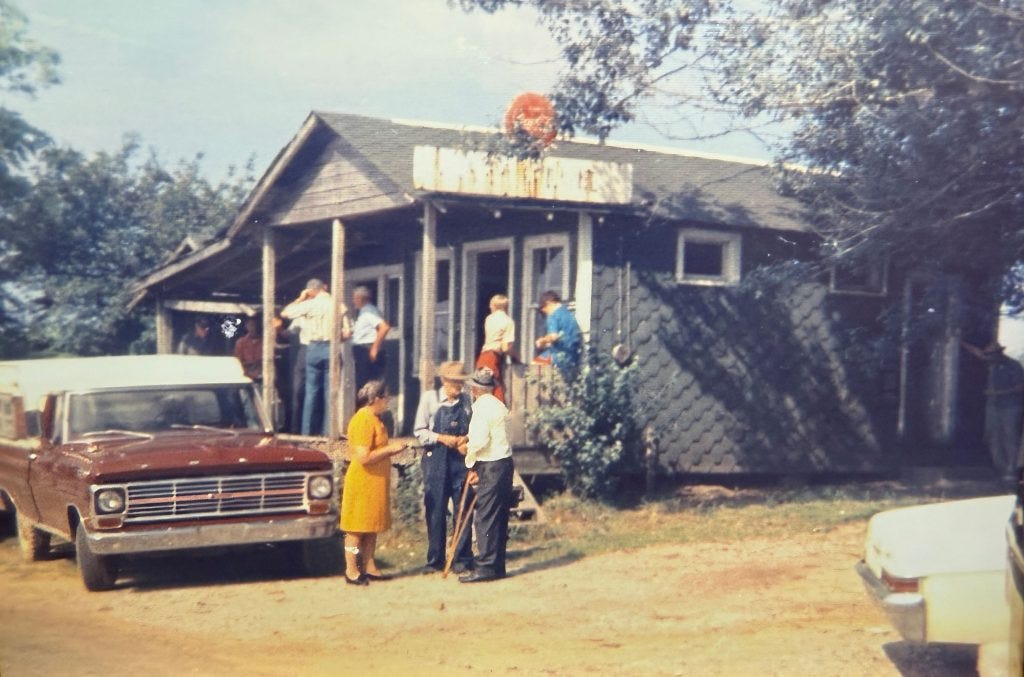
Scott County communities: Black Oak
Which of Scott County’s communities came first?
That’s difficult to say without knowing exactly who was the first to settle Scott County — or, rather, the first to settle the lands that would eventually become Scott County, since they were a part of Campbell, Anderson and Morgan counties until 1849 (and some of the northern areas were originally considered part of Wayne County and even Pulaski County, Ky., in the earliest days).
Mikel Low is traditionally considered the first permanent white settler in Scott County, which would make Smokey Creek the first community. But other communities with claims of being first would include Chitwood (Winfield), New River, Brimstone, Buffalo, and Paint Rock. Between the years of 1806 and 1810, settlement had begun in earnest in these areas, almost always beginning with the fertile bottomlands along the streams.
Long before things had consolidated and Oneida grew into Scott County’s economic hub, with Huntsville as the county’s industrial hub, each community was largely self-sustainable, with mills, stores, schools, post offices, and more. They were connected by the main roads through this rugged plateau land, which mostly followed old Indian trails that had been used for ages before people of European descent stumbled upon the scene.
Over the next several weeks, the Independent Herald‘s “Echoes in Time” series will reflect on the history of these communities, drawing from the Encyclopedia of Scott County (www.ihoneida.com). Also, the Scott County Historical Society has a forthcoming book, “Communities of Scott County,” that will be available for purchase at their offices, located on the second floor of the old Scott County Courthouse in Huntsville (open Tuesday and Thursday mornings).
This series is not an attempt to profile Scott County’s communities in the order they were settled, which would likely be an exercise in futility. Rather, it is simply an alphabetical listing.
Black Oak
Located west of Oneida, Black Oak is a part of the 37841 zip code, and is sometimes called Possum Rock or Leatherwood. It is generally considered to be the S.R. 297 corridor from the intersection of Station Camp Road to Leatherwood Ford in the Big South Fork National River & Recreation Area. Some might also consider the Toomey Road area to be part of Black Oak, including the new Toomey Falls subdivision. Surrounding communities include Station Camp to the north, Coopertown and Verdun to the east, White Pine to the west, and Helenwood to the south.
Because there are no specific boundaries, there is no way to accurately measure the population of the Black Oak community.
Major streams that drain the Black Oak community include Anderson Branch and Bill Branch on the west side of S.R. 297, both of which empty into the Big South Fork River. Areas east of S.R. 297 drain into Pine Creek, with the help of Mill Branch, which heads up at Lake Arlie — named for Oneida businessman Arlie Lay, who built it and whose family still owns it.
Post Office: The Black Oak community is served by the Oneida post office today. Even in the days when post offices dotted the map in rural Scott County, there were never any post offices located in the Black Oak community. The closest rural post offices, outside Oneida, were Elva, Zena and Frona, all located in the Station Camp and No Business areas west of the Big South Fork River.
Schools: The only historical school in the Black Oak community was O’Possum Rock School, which was located at the intersection of S.R. 297 (Leatherwood Road) and Camp Road. A building that once housed the school still stands, though it is abandoned and in a serious state of disrepair. Today, Black Oak is served by Burchfield School for grades K-8 and Scott High School for grades 9-12.
Business & Commerce: Major businesses in the Black Oak community include Carson’s Truss, a family-owned builder of custom wooden trusses that is owned by Benny Carson, and Jet Machining Inc. One of the community’s longest-running businesses was Terry & Terry Store, located at the intersection of Coopertown, Leatherwood and Station Camp roads, but it closed with the death of its last surviving owner, Bertha Terry, in 2007. Her sister and the store’s co-owner, Dorothy Terry, died in 1993. Another old store, the Tom Payne Store, was owned by Thomas Miller Payne. The store closed after his death in 1959, but continued to be used as a voting precinct until it was destroyed by a tornado on April 3, 1974. It was located just east of where Leatherwood Baptist Church is located. In more recent years, there was a store called Last Chance, located just west of Leatherwood Baptist Church. The building that housed it is used today as a private residence.
Churches: There are two Baptist churches in the Black Oak community: Black Oak Baptist Church and Leatherwood Baptist Church (formerly known as O’Possum Rock Baptist Church). Black Oak Baptist was originally located next-door to Carson’s Truss Co. but later moved to its current location on Coopertown Road. O’Possum Rock Baptist changed its name and signage to match the nearby landmark in the Big South Fork NRRA.
Cemeteries: The largest cemetery in the community is the O’Possum Rock Cemetery, which is sometimes called the Black Oak Cemetery. The oldest cemetery is the largely forgotten Keeton Cemetery. There is also the Miller Family Cemetery, Ike Smith Cemetery, Trosper Cemetery, the Ovie Smith Cemetery, and the William Smith Cemetery.
Origins: Unfortunately, there isn’t a lot of information available about the history of the Black Oak community. It was not a major settlement in the early 19th century like other parts of Scott County. The river bottoms to the immediate west — including Station Camp, Parch Corn, and No Business — were earlier settlements than Black Oak.
Black Oak got its name for the black oaks and red oaks that once grew in abundance there, according to the historian H. Clay Smith. The original wagon road through the community followed roughly the same route that S.R. 297 now takes, although there were some variances. Additionally, the O’Possum Rock community, a bit further west towards Leatherwood, was once considered a separate community from Black Oak. Today, the name Black Oak generally incorporates both areas.
Adjoining the Black Oak community was a Welsh settlement in the mid 1800s known as Brynffynon, founded by Samuel Roberts. It extended from present-day Pistol Lane and across present-day Toomey Road. The Civil War spelled the end of the Brynffynon settlement, leaving its owners desolate.
First Families: The first family to permanently settle at Black Oak may have been the Thompson family, which lived where Old Litton Place is now located.
Lewis Thompson (1792-1863) is the oldest grave found at the Keeton Cemetery at Black Oak, though that cannot be conclusively proven. The stone is engraved only with the initials “L.T.” However, Thompson was known to have lived in the area. His first marriage was to Pheby Gray. He later married Mary “Polly” Brown (1826-1902) in 1849. He had at least 11 children.
Elzwick Thompson (1818-1904) is also buried at Keeton Cemetery. He was one of Lewis Thompson’s children. His wife, Nancy Brown (1827-1905), is buried at the cemetery, as well.
Another relatively early family of the Black Oak community was the Terry family, which eventually included sisters Bertha and Dorothy Terry, who married brothers and were the owners and operators of Terry & Terry Store.
One of the first members of the Terry family to live at Black Oak was Miles Terry (1848-1929), who married Artema “Artie” Coyle (1843-1911). Artie was one of the first people buried at O’Possum Rock Cemetery. She and Miles had eight children, and the extensive Terry family of the Black Oak community descended from them.
Miles Terry was the son of Martin Terry (1832-1890), and a grandson of Josiah Terry (1780-1868), the first settler of Oneida. Descendants of Miles Terry still have substantial landholdings in the Black Oak community today.
Although they weren’t the first family to live at Black Oak, there has been no family in the community more consequential than the Miller family. Originally from No Business, William J. Miller (1895-1980) and Ellen Burk (1893-1996) moved to Black Oak and established a farm during the Great Depression era, when they tired of flooding rains drowning their cornfields near the Big South Fork River.
Will Miller was the son of Francis Miller, who owned a store near the mouth of No Business Creek. Ellen Burk was the daughter of Lewis Burk and a great-granddaughter of Jonathan Burke, an early settler of the Parch Corn section of Big South Fork. It was at Jonathan Burke’s cabin that the Battle of No Business was fought in 1863. Francis Miller later purchased the cabin and moved it to No Business, and it was there that Will Miller was raised.
Will and Ellen’s children included Laura Boyatt (1919-2009), Hester Kidd (1921-1996), Lenord Miller (1924-2012), Eva Payne (1926-2019), Lorene Phillips (1929-2021), Elizabeth Harris (1933-2016), and Lillard Miller (1936-2023). Most of their children remained in the Black Oak area for their entire lives, and many of their descendants — Millers, Boyatts, Paynes, and Carsons — remain in the community today. It was Eva Payne’s father-in-law who owned Tom Payne Store at Black Oak, and it is Laura Boyatt’s son-in-law, Benny Carson, who owns Carson Truss Co.
Of course, no discussion of the early families of Black Oak would be complete without mentioning the Smith family, including the sons of Samuel and Sally Smith. One of them, William “Bill” Smith (1870-1931) and his wife, Sarah Slaven (1865-1933), are buried at the William Smith Cemetery at Old Litton Place, just a stone’s throw from the Keeton Cemetery. William’s better-known brother was John J. “Hawk” Smith, the noted Big South Fork resident who lived near what is Angel Falls Village today.
Samuel and John Hawk were the grandsons of Anderson Smith (1800-1890) and Sarah Slaven (1796-1888), who had a farm on Station Camp Creek. Sarah was a daughter of Richard Harve Slaven, who is believed to have been the Big South Fork region’s first permanent white settler.
Bill and Sarah had at least six children, and those children married into the Terry and Keeton families that lived at Black Oak.
Thank you for reading. Our next newsletter will be Threads of Life tomorrow. If you’d like to update your subscription to add or subtract any of our newsletters, do so here. If you haven’t yet subscribed, it’s as simple as adding your email address!
◼️ About the IH • IH Sports Network • The Encyclopedia of Scott County
◼️ Subscribe • Sponsor • Manage Your Account
◼️ Follow us on Facebook, Instagram, X/Twitter, YouTube
Our Newsletters:
• Monday morning: The Daybreaker (news & the week ahead)
• Tuesday: Echoes from the Past (stories of our history)
• Wednesday: Threads of Life (obituaries)
• Thursday evening: The Weekender (news & the weekend)
• Friday: Friday Features (beyond the news)
• Sunday: Varsity (a weekly sports recap)